Physics:Quantum Computing Algorithms in the NISQ Era: Difference between revisions
Normalize quantum page header order |
WikiHarold (talk | contribs) Restore missing Quantum reference definitions |
||
| Line 50: | Line 50: | ||
finance, and accelerating certain kinds of machine-learning and search tasks. Researchers | finance, and accelerating certain kinds of machine-learning and search tasks. Researchers | ||
have already demonstrated early milestones where quantum processors performed narrowly defined tasks far faster than classical machines, milestones sometimes called quantum supremacy or quantum advantage. These show the field is progressing from | have already demonstrated early milestones where quantum processors performed narrowly defined tasks far faster than classical machines, milestones sometimes called quantum supremacy or quantum advantage. These show the field is progressing from | ||
theory toward demonstrable speedups <ref name="01Z" /><ref name="02Z" /><ref name="03Z" /><ref name="04Z" /><ref name="05Z" />. The current era, often referred to as the NISQ (Noisy Intermediate-Scale Quantum) era, is characterized by machines with tens to hundreds of qubits that are inherently noisy and prone to errors. Fully fault-tolerant, error-corrected quantum computing remains an engineering challenge, but progress is rapid. Large technology companies and startups alike continue to | theory toward demonstrable speedups <ref name="01Z">M. AbuGhanem. Superconducting quantum computers: who is leading the future? ''EPJ Quantum Technol.'', 12:102, 2025. {{doi|10.1140/epjqt/s40507-025-00405-7}}</ref><ref name="02Z">M. S. Akter, J. Rodriguez-Cardenas, H. Shahriar, A. Cuzzocrea, and F. Wu. Quantum cryptography for enhanced network security: a comprehensive survey of research, developments, and future directions. In ''IEEE Big Data 2021'', pages 5408–5417, 2023. {{doi|10.1109/bigdata59044.2023.10386889}}</ref><ref name="03Z">L. Andersen, P. Berta, and C. Rebentrost. Hardware–software co-design for quantum advantage: bridging algorithms and architectures. ''Nat. Rev. Phys.'', 7:450–464, 2025. {{doi|10.1038/s42254-025-00918-z}}</ref><ref name="04Z">F. Arute et al. Quantum supremacy using a programmable superconducting processor. ''Nature'', 574:505–510, 2019. {{doi|10.1038/s41586-019-1666-5}}</ref><ref name="05Z">Y. Baseri, V. Chouhan, and A. Hafid. Navigating quantum security risks in networked environments: a comprehensive study of quantum-safe network protocols. ''Comput. Secur.'', 142:103883, 2024. {{doi|10.1016/j.cose.2024.103883}}</ref>. The current era, often referred to as the NISQ (Noisy Intermediate-Scale Quantum) era, is characterized by machines with tens to hundreds of qubits that are inherently noisy and prone to errors. Fully fault-tolerant, error-corrected quantum computing remains an engineering challenge, but progress is rapid. Large technology companies and startups alike continue to | ||
publish new processors, algorithms, and roadmaps. Quantum | publish new processors, algorithms, and roadmaps. Quantum | ||
computing is no longer just a theoretical curiosity, it is an active, multidisciplinary race among physicists, engineers, and computer scientists to turn exotic quantum effects into practical advantage.<ref name="06Z" /><br> | computing is no longer just a theoretical curiosity, it is an active, multidisciplinary race among physicists, engineers, and computer scientists to turn exotic quantum effects into practical advantage.<ref name="06Z">F. Bauer-Marquart, S. Leue, and C. Schilling. symQV: automated symbolic verification of quantum programs. arXiv:2212.02267, 2022. (No published DOI).</ref><br> | ||
==='''Keywords:'''=== | ==='''Keywords:'''=== | ||
| Line 130: | Line 130: | ||
==Promising Age of Quantum Computing== | ==Promising Age of Quantum Computing== | ||
Photonic quantum computers are currently prominent contenders in fault-tolerant quantum computation (FTQC). These advanced architectures utilize photons as the medium for qubit encoding and manipulation <ref>{{cite journal | last = O'Brien | first = Jeremy L. | title = Optical Quantum Computing | journal = Science | volume = 318 | issue = 5856 | pages = 1567–1570 | date = 7 December 2007 | doi = 10.1126/science.1142892 | url = https://www.science.org/doi/10.1126/science.1142892 }}</ref>, exhibiting inherent resilience against decoherence and noise, even at room temperature. This makes them exceptionally well-suited for scalable and FTQC. Photonic quantum computing also stands out for enabling the construction of modular, easily networked quantum computers, holding significant potential for practical applications <ref>{{cite journal | last1 = AbuGhanem | first1 = M. | last2 = Eleuch | first2 = H. | title = NISQ Computers: A Path to Quantum Supremacy | journal = IEEE Access | volume = 12 | pages = 102941–102961 | year = 2024 | doi = 10.1109/ACCESS.2024.3432330 | url = https://ieeexplore.ieee.org/document/10606265 }}</ref><ref>{{cite journal | last1 = Giordani | first1 = T. | last2 = Hoch | first2 = F. | last3 = Carvacho | first3 = G. | last4 = Spagnolo | first4 = N. | last5 = Sciarrino | first5 = F. | title = Integrated photonics in quantum technologies | journal = La Rivista del Nuovo Cimento | volume = 46 | issue = 2 | pages = 71–103 | year = 2023 | doi = 10.1007/s40766-023-00040-x | url = https://link.springer.com/article/10.1007/s40766-023-00040-x }}</ref>. | Photonic quantum computers are currently prominent contenders in fault-tolerant quantum computation (FTQC). These advanced architectures utilize photons as the medium for qubit encoding and manipulation <ref>{{cite journal | last = O'Brien | first = Jeremy L. | title = Optical Quantum Computing | journal = Science | volume = 318 | issue = 5856 | pages = 1567–1570 | date = 7 December 2007 | doi = 10.1126/science.1142892 | url = https://www.science.org/doi/10.1126/science.1142892 }}</ref>, exhibiting inherent resilience against decoherence and noise, even at room temperature. This makes them exceptionally well-suited for scalable and FTQC. Photonic quantum computing also stands out for enabling the construction of modular, easily networked quantum computers, holding significant potential for practical applications <ref>{{cite journal | last1 = AbuGhanem | first1 = M. | last2 = Eleuch | first2 = H. | title = NISQ Computers: A Path to Quantum Supremacy | journal = IEEE Access | volume = 12 | pages = 102941–102961 | year = 2024 | doi = 10.1109/ACCESS.2024.3432330 | url = https://ieeexplore.ieee.org/document/10606265 }}</ref><ref>{{cite journal | last1 = Giordani | first1 = T. | last2 = Hoch | first2 = F. | last3 = Carvacho | first3 = G. | last4 = Spagnolo | first4 = N. | last5 = Sciarrino | first5 = F. | title = Integrated photonics in quantum technologies | journal = La Rivista del Nuovo Cimento | volume = 46 | issue = 2 | pages = 71–103 | year = 2023 | doi = 10.1007/s40766-023-00040-x | url = https://link.springer.com/article/10.1007/s40766-023-00040-x }}</ref>. | ||
Many scientists believe that the first thoughts about quantum computers emerged with the 1982 lecture by Richard Feynman <ref name="01Y"/><ref name="02Y"/>. Feynman had envisioned the possibility of creating a quantum machine that can reproduce quantum physics on the basis of the principles of quantum mechanics. In Feynman’s conception, computers compatible with the basic principles of quantum mechanics may be needed to model natural phenomena because "Nature is fundamentally quantum mechanical" <ref name="03Y"/>.<br>The development of quantum computers has revealed many possibilities for such thoughts to be translated into reality because they are able to utilize the vast calculation capabilities needed to model quantum systems in a way that takes advantage of the properties offered by quantum mechanics, including superposition, interference, and entanglement <ref name="04Y"/>. The pace of progress in developing a physical quantum computer was glacial, due in part to difficult technical difficulties that make it difficult to shield and consistently control the dynamics of the quantum mechanical properties manifested at such very basic scales of nature as electron spin or photon polarization <ref name="05Y"/>. | Many scientists believe that the first thoughts about quantum computers emerged with the 1982 lecture by Richard Feynman <ref name="01Y">T. Hey. Richard Feynman and computation. Contemporary Physics, vol. 40, no. 4, pp. 257–265, 1999. {{doi|10.1080/001075199181549}}</ref><ref name="02Y">J. Preskill. Quantum computing 40 years later. In Feynman Lectures on Computation, pp. 193–244, CRC Press, 2023. ISBN 9781003410027. {{doi|10.1201/9781003410027}}</ref>. Feynman had envisioned the possibility of creating a quantum machine that can reproduce quantum physics on the basis of the principles of quantum mechanics. In Feynman’s conception, computers compatible with the basic principles of quantum mechanics may be needed to model natural phenomena because "Nature is fundamentally quantum mechanical" <ref name="03Y">V. Silva. Richard Feynman, demigod of physics, father of the quantum computer. In Quantum Computing by Practice: Python Programming in the Cloud with Qiskit and IBM-Q, pp. 49–85, Springer, 2023. {{doi|10.1007/978-1-4842-9991-3_3}}</ref>.<br>The development of quantum computers has revealed many possibilities for such thoughts to be translated into reality because they are able to utilize the vast calculation capabilities needed to model quantum systems in a way that takes advantage of the properties offered by quantum mechanics, including superposition, interference, and entanglement <ref name="04Y">Z. Yang, M. Zolanvari, and R. Jain. A survey of important issues in quantum computing and communications. IEEE Communications Surveys & Tutorials, 2023. {{doi|10.1109/COMST.2023.3252240}}</ref>. The pace of progress in developing a physical quantum computer was glacial, due in part to difficult technical difficulties that make it difficult to shield and consistently control the dynamics of the quantum mechanical properties manifested at such very basic scales of nature as electron spin or photon polarization <ref name="05Y">M. Mikkelsen, J. Berezovsky, N. Stoltz, L. Coldren, and D. Awschalom. Optically detected coherent spin dynamics of a single electron in a quantum dot. Nature Physics, vol. 3, no. 11, pp. 770–773, 2007. {{doi|10.1038/nphys722}}</ref>. | ||
===From Classical to Quantum Optimization === | ===From Classical to Quantum Optimization === | ||
| Line 164: | Line 164: | ||
Recent survey work synthesizes how quantum algorithms map | Recent survey work synthesizes how quantum algorithms map | ||
onto real-world application areas, such as chemistry, optimization, | onto real-world application areas, such as chemistry, optimization, | ||
cryptography, machine learning, and finance carefully weighing theoretical speedups against practical resource costs and engineering constraints. Dalzell <ref name="07Z" /> provide a useful, application-oriented perspective that emphasizes subtle caveats regarding when quantum advantage actually materializes and the need for end-to-end complexity considerations <ref name="07Z" />. Contemporary literature stresses that theoretical asymptotics (e.g., Shor’s | cryptography, machine learning, and finance carefully weighing theoretical speedups against practical resource costs and engineering constraints. Dalzell <ref name="07Z">P. Benioff. The computer as a physical system: a microscopic quantum mechanical Hamiltonian model of computers as represented by turing machines. ''J. Stat. Phys.'', 22:563–591, 1980. {{doi|10.1007/BF01011339}}</ref> provide a useful, application-oriented perspective that emphasizes subtle caveats regarding when quantum advantage actually materializes and the need for end-to-end complexity considerations <ref name="07Z" />. Contemporary literature stresses that theoretical asymptotics (e.g., Shor’s | ||
exponential speedup) must be evaluated alongside requirements for fault tolerance, qubit counts, and realistic gate/noise budgets<ref name="08Z" /><ref name="06Z" /><ref name="09Z" />. Beyond these, Huynh et al. <ref name="10Z" /> explore quantum-inspired | exponential speedup) must be evaluated alongside requirements for fault tolerance, qubit counts, and realistic gate/noise budgets<ref name="08Z">G. Brassard, P. Høyer, M. Mosca, and A. Tapp. Quantum amplitude amplification and estimation. arXiv:quant-ph/0005055, 2000. (No published DOI).</ref><ref name="06Z" /><ref name="09Z">M. Carter and E. Gheorghiu. QBench and QPack: frameworks for benchmarking quantum algorithms. ''ACM Trans. Quantum Comput.'', 6(3), 2024. {{doi|10.1145/3691041}}</ref>. Beyond these, Huynh et al. <ref name="10Z">CertiQ. CertiQ – compiler/circuit equivalence verification. arXiv, 2025. (No published DOI).</ref> explore quantum-inspired | ||
machine-learning approaches that bridge classical and quantum paradigms, offering hybrid algorithms deployable on today’s near-term hardware <ref name="10Z" />. Grigoryan et al. <ref name="11Z" /> provides a comprehensive review of quantum-computing models, including gate-based, adiabatic, and measurement-based approaches,analyzing their algorithmic implications and domain specific applications <ref name="11Z" />. Industry-oriented | machine-learning approaches that bridge classical and quantum paradigms, offering hybrid algorithms deployable on today’s near-term hardware <ref name="10Z" />. Grigoryan et al. <ref name="11Z">E. Chae, J. Choi, and J. Kim. An elementary review on basic principles and developments of qubits for quantum computing. ''Nano Converg.'', 11:11, 2024. {{doi|10.1186/s40580-024-00418-5}}</ref> provides a comprehensive review of quantum-computing models, including gate-based, adiabatic, and measurement-based approaches,analyzing their algorithmic implications and domain specific applications <ref name="11Z" />. Industry-oriented | ||
analyses published in EPJ Quantum Technology <ref name="12Z" /> emphasize how algorithmic progress interacts with hardware engineering, highlighting persistent gaps between theoretical quantum advantage and practical scalability <ref name="12Z" />. Additionally, the Quantum Algorithm Zoo <ref name="13Z" /> serves as an evolving catalogue of hundreds of quantum algorithms, classified by domain and computational model, offering researchers a living reference for tracking progress across the field <ref name="13Z" />. Together, these surveys illustrate that while theoretical speedups remain intellectually compelling, their translation into practical advantage depends critically on hardware maturity, hybrid algorithm design, and | analyses published in EPJ Quantum Technology <ref name="12Z">S.-J. Chen and Y. Tsai. Quantum-safe networks for 6G. 2:1, 2025. {{doi|10.69709/caic.2025.102135}}</ref> emphasize how algorithmic progress interacts with hardware engineering, highlighting persistent gaps between theoretical quantum advantage and practical scalability <ref name="12Z" />. Additionally, the Quantum Algorithm Zoo <ref name="13Z">J.-S. Chen, E. Nielsen, M. Ebert, V. Inlek, K. Wright, V. Chaplin, et al. Benchmarking a trapped-ion quantum computer with 30 qubits. ''Quantum'', 8:1516, 2024. {{doi|10.22331/q-2024-11-07-1516}}</ref> serves as an evolving catalogue of hundreds of quantum algorithms, classified by domain and computational model, offering researchers a living reference for tracking progress across the field <ref name="13Z" />. Together, these surveys illustrate that while theoretical speedups remain intellectually compelling, their translation into practical advantage depends critically on hardware maturity, hybrid algorithm design, and | ||
integrated benchmarking frameworks. Quantum computers work by within the rules of quantum mechanics to overcome problems that regular computers struggle with. They've evolved, from early ideas rooted in quantum physics to practical uses in computer science today <ref name="02Y" />. Building a full-scale, industrial quantum computer is a big deal; it could shake up fields like cybersecurity and beyond. | integrated benchmarking frameworks. Quantum computers work by within the rules of quantum mechanics to overcome problems that regular computers struggle with. They've evolved, from early ideas rooted in quantum physics to practical uses in computer science today <ref name="02Y" />. Building a full-scale, industrial quantum computer is a big deal; it could shake up fields like cybersecurity and beyond. | ||
The first real quantum algorithm that outpaced classical ones came from Daniel Simon <ref name="32Y" />. Then came others like the Deutsch-Jozsa algorithm, which tackles problems needing tons of queries exponentially faster, basically, it cuts down the computing grunt work to check if algorithms are balanced or robust. The Bernstein-Vazirani algorithm solves "black-box" puzzles efficiently, Simon's speeds up certain computations, and Shor's is cracking integer factorization and discrete logarithm problems <ref name="04Y" />. All these rely on the quantum Fourier transform. | The first real quantum algorithm that outpaced classical ones came from Daniel Simon <ref name="32Y">D. R. Simon. On the power of quantum computation. SIAM journal on computing, vol. 26, no. 5, pp. 1474–1483, 1997. {{doi|10.1137/S0097539796298637}}</ref>. Then came others like the Deutsch-Jozsa algorithm, which tackles problems needing tons of queries exponentially faster, basically, it cuts down the computing grunt work to check if algorithms are balanced or robust. The Bernstein-Vazirani algorithm solves "black-box" puzzles efficiently, Simon's speeds up certain computations, and Shor's is cracking integer factorization and discrete logarithm problems <ref name="04Y" />. All these rely on the quantum Fourier transform. | ||
Grover's algorithm is developed for searching unstructured databases to find specific items, and quantum counting handles broader searches. Both use "amplitude amplification," that boosts quantum computers ability to solve problems way faster than old-school methods. This technique powers other quantum fields, like machine learning, simulations, and advanced searches. | Grover's algorithm is developed for searching unstructured databases to find specific items, and quantum counting handles broader searches. Both use "amplitude amplification," that boosts quantum computers ability to solve problems way faster than old-school methods. This technique powers other quantum fields, like machine learning, simulations, and advanced searches. | ||
More recently, there's the quantum approximate optimization algorithm, which focuses on graph theory problems <ref name="33Y" />. It mixes quantum and classical computing in a hybrid setup. | More recently, there's the quantum approximate optimization algorithm, which focuses on graph theory problems <ref name="33Y">E. Farhi, J. Goldstone, and S. Gutmann. A quantum approximate optimization algorithm. arXiv preprint arXiv:1411.4028, 2014. {{doi|10.48550/arXiv.1411.4028}}</ref>. It mixes quantum and classical computing in a hybrid setup. | ||
Basically, quantum software comes down to two main models that shape programs and their use: the quantum gate model <ref name="34Y" /> and quantum annealing <ref name="35Y" />. | Basically, quantum software comes down to two main models that shape programs and their use: the quantum gate model <ref name="34Y">C. P. Williams. Quantum Gates. pp. 51–122. London: Springer London, 2011. {{doi|10.1007/978-1-84882-775-2_4}}</ref> and quantum annealing <ref name="35Y">W. Du, B. Li, and Y. Tian. Quantum annealing algorithms: State of the art. Jisuanji Yanjiu yu Fazhan/Computer Research and Development, vol. 45, no. 9, p. 1501 – 1508, 2008. No DOI.</ref>. | ||
The gate model is like a quantum version of classical logic gates. It manipulates qubits (quantum bits) using gates that tap into cool quantum effects like superposition (being in multiple states at once) and entanglement (linked particles influencing each other instantly). It's an approach, using algorithms like Shor's or Grover's, so it has many applications. The challenge is decoherence, where quantum states fail quickly, so error correction is crucial. | The gate model is like a quantum version of classical logic gates. It manipulates qubits (quantum bits) using gates that tap into cool quantum effects like superposition (being in multiple states at once) and entanglement (linked particles influencing each other instantly). It's an approach, using algorithms like Shor's or Grover's, so it has many applications. The challenge is decoherence, where quantum states fail quickly, so error correction is crucial. | ||
| Line 183: | Line 183: | ||
==Emerging paradigm== | ==Emerging paradigm== | ||
Quantum computing is a new paradigm that draws on the following principles of quantum mechanics:<br>Quantum mechanics to tackle computational difficulties that cannot be addressed by classical computers. This article gives a brief introduction to the basic concepts of qubits, the unique properties of quantum mechanics including superposition, interference, uncertainty relations, superposition and entanglement, and the problem of creating scalable, fault-tolerant systems. It discusses important quantum algorithms and the possibilities.<br>Applications in areas such as cryptography, optimization, finance, chemistry, among many other including machine learning. It emphasizes the significance of verification frameworks for the verification of quantum programs’ reliability <ref name="18Z" />. Literature reviews examples of significant contributions include a presentation on insights derived from recent surveys on quantum algorithms, qubit technologies, and software verification methods. A discussion about challenges that still need to be met, like correcting errors.<ref name="03Z" /><br>Several key issues in modern micro-architecture design, such as overhead, hardware directions for future research. | Quantum computing is a new paradigm that draws on the following principles of quantum mechanics:<br>Quantum mechanics to tackle computational difficulties that cannot be addressed by classical computers. This article gives a brief introduction to the basic concepts of qubits, the unique properties of quantum mechanics including superposition, interference, uncertainty relations, superposition and entanglement, and the problem of creating scalable, fault-tolerant systems. It discusses important quantum algorithms and the possibilities.<br>Applications in areas such as cryptography, optimization, finance, chemistry, among many other including machine learning. It emphasizes the significance of verification frameworks for the verification of quantum programs’ reliability <ref name="18Z">A. M. Dalzell. Quantum algorithms: a survey of applications and end-to-end complexities. Cambridge University Press, 2023. (No DOI).</ref>. Literature reviews examples of significant contributions include a presentation on insights derived from recent surveys on quantum algorithms, qubit technologies, and software verification methods. A discussion about challenges that still need to be met, like correcting errors.<ref name="03Z" /><br>Several key issues in modern micro-architecture design, such as overhead, hardware directions for future research. | ||
== Quantum Advantage: From NISQ to Fault-Tolerance == | == Quantum Advantage: From NISQ to Fault-Tolerance == | ||
'''Quantum advantage''' refers to scenarios where quantum computers perform tasks that classical computers cannot solve efficiently, as demonstrated in supremacy experiments involving random circuit sampling<ref name="04Z"/><ref name="15Y"/>. Current devices, known as '''NISQ systems''' (Noisy Intermediate-Scale Quantum), utilize hybrid quantum-classical algorithms to mitigate hardware limitations through classical optimization feedback<ref name="05X"/><ref name="12Y"/>. While these systems excel in variational methods for simulation and optimization, they suffer from decoherence that limits computation time and introduces errors. Consequently, techniques such as '''probabilistic error cancellation''' and '''zero-noise extrapolation''' are essential<ref name="56Z"/><ref name="38W"/>. | '''Quantum advantage''' refers to scenarios where quantum computers perform tasks that classical computers cannot solve efficiently, as demonstrated in supremacy experiments involving random circuit sampling<ref name="04Z"/><ref name="15Y">F. Arute, K. Arya, R. Babbush, D. Bacon, J. C. Bardin, R. Barends, R. Biswas, S. Boixo, F. G. Brandao, D. A. Buell, et al. Quantum supremacy using a programmable superconducting processor. Nature, vol. 574, no. 7779, pp. 505–510, 2019. {{doi|10.1038/s41586-019-1666-5}}</ref>. Current devices, known as '''NISQ systems''' (Noisy Intermediate-Scale Quantum), utilize hybrid quantum-classical algorithms to mitigate hardware limitations through classical optimization feedback<ref name="05X">Arute, F. et al. Quantum supremacy using a programmable superconducting processor. *Nature* **574**, 505–510 (2019).</ref><ref name="12Y">J. Preskill. Quantum computing in the nisq era and beyond. Quantum, vol. 2, p. 79, 2018. {{doi|10.22331/q-2018-08-06-79}}</ref>. While these systems excel in variational methods for simulation and optimization, they suffer from decoherence that limits computation time and introduces errors. Consequently, techniques such as '''probabilistic error cancellation''' and '''zero-noise extrapolation''' are essential<ref name="56Z">QHLProver. QHLProver – Quantum hoare logic prover. arXiv, 2025. (No published DOI).</ref><ref name="38W">P. Czarnik, A. Arrasmith, P. J. Coles, and L. Cincio. Error mitigation with clifford quantum-circuit data. Quantum, 5:592, Nov. 2021. ISSN 2521-327X. doi: 10.22331/q-2021-11-26-592. URL http://dx.doi.org/10.22331/q-2021-11-26-592.</ref>. | ||
=== The NISQ Bridge and AI Integration === | === The NISQ Bridge and AI Integration === | ||
NISQ serves as a vital bridge between theoretical promise and practical utility. Quantum sensors and memories can exponentially enhance our ability to learn about physical systems, a claim recently validated in experimental settings<ref name="121W"/><ref name="67W"/>. For instance, quantum devices enable the efficient characterization of many-body physics by leveraging AI for noise mitigation and circuit optimization<ref name="132W"/><ref name="133W"/>. AI is now indispensable across the entire quantum stack: from qubit design and calibration to real-time error correction and the interpretation of complex output<ref name="13X"/><ref name="17X"/><ref name="19X"/>. This hardware-algorithm co-design is crucial for overcoming "barren plateaus" in variational training landscapes<ref name="08W"/><ref name="09W"/>. | NISQ serves as a vital bridge between theoretical promise and practical utility. Quantum sensors and memories can exponentially enhance our ability to learn about physical systems, a claim recently validated in experimental settings<ref name="121W">E. Tang. A quantum-inspired classical algorithm for recommendation systems. In Proceedings of the 51st annual ACM SIGACT symposium on theory of computing, pages 217–228, 2019.</ref><ref name="67W">H.-Y. Huang, M. Broughton, J. Cotler, S. Chen, J. Li, M. Mohseni, H. Neven, R. Babbush, R. Kueng, J. Preskill, et al. Quantum advantage in learning from experiments. Science, 376(6598):1182–1186, 2022.</ref>. For instance, quantum devices enable the efficient characterization of many-body physics by leveraging AI for noise mitigation and circuit optimization<ref name="132W">N. Wiebe, C. Granade, C. Ferrie, and D. Cory. Hamiltonian learning and certification using quantum resources. Physical Review Letters, 112(19), 2014. ISSN 1079-7114. doi: 10.1103/physrevlett.112.190501. URL http://dx.doi.org/10.1103/PhysRevLett.112.190501.</ref><ref name="133W">N. Wiebe, C. Granade, and D. G. Cory. Quantum bootstrapping via compressed quantum hamiltonian learning. New Journal of Physics, 17(2):022005, Feb. 2015. ISSN 1367-2630. doi: 10.1088/1367-2630/17/2/022005. URL http://dx.doi.org/10.1088/1367-2630/17/2/022005.</ref>. AI is now indispensable across the entire quantum stack: from qubit design and calibration to real-time error correction and the interpretation of complex output<ref name="13X">Yenduri, G. et al. Gpt (generative pre-trained transformer)-a comprehensive review on enabling technologies, potential applications, emerging challenges, and future directions. *IEEE Access* (2024).</ref><ref name="17X">Hornik, K., Stinchcombe, M. & White, H. Multilayer feedforward networks are universal approximators. *Neural Netw.* **2**, 359–366 (1989).</ref><ref name="19X">Chen, M. et al. Grovergpt-2: Simulating grover's algorithm via chain-of-thought reasoning and quantum-native tokenization. Preprint at https://doi.org/10.48550/arXiv.2505.04880 (2025).</ref>. This hardware-algorithm co-design is crucial for overcoming "barren plateaus" in variational training landscapes<ref name="08W">A. Arrasmith, M. Cerezo, P. Czarnik, L. Cincio, and P. J. Coles. Effect of barren plateaus on gradient-free optimization. Quantum, 5:558, Oct. 2021. ISSN 2521-327X. doi: 10.22331/q-2021-10-05-558. URL http://dx.doi.org/10.22331/q-2021-10-05-558.</ref><ref name="09W">A. Arrasmith, Z. Holmes, M. Cerezo, and P. J. Coles. Equivalence of quantum barren plateaus to cost concentration and narrow gorges. Quantum Science and Technology, 7(4):045015, Aug. 2022. ISSN 2058-9565. doi: 10.1088/2058-9565/ac7d06. URL http://dx.doi.org/10.1088/2058-9565/ac7d06.</ref>. | ||
=== The Transition to Fault-Tolerant Computing (FTQC) === | === The Transition to Fault-Tolerant Computing (FTQC) === | ||
In contrast to the heuristic nature of NISQ, '''Fault-Tolerant Quantum Computing (FTQC)''' employs error-correcting codes to create reliable logical qubits from noisy physical ones, enabling scalable computation for high-complexity problems<ref name="02W"/><ref name="24Z"/>. However, this transition requires massive overhead; executing algorithms such as Shor’s for cryptography may necessitate millions of physical qubits<ref name="52Z"/><ref name="18Z"/>. The path toward full FTQC involves intermediate '''partial error correction''' phases, where users dynamically allocate resources between corrected and uncorrected qubits to optimize performance based on available hardware<ref name="03X"/><ref name="197X"/>. | In contrast to the heuristic nature of NISQ, '''Fault-Tolerant Quantum Computing (FTQC)''' employs error-correcting codes to create reliable logical qubits from noisy physical ones, enabling scalable computation for high-complexity problems<ref name="02W">S. Aaronson. Shadow tomography of quantum states. In ''Proceedings of the 50th Annual ACM SIGACT Symposium on Theory of Computing'' (STOC 2018), pages 325–338, 2018. {{doi|10.1145/3188745.3188807}}</ref><ref name="24Z">R. P. Feynman. Simulating physics with computers. ''Int. J. Theor. Phys.'', 21:467–488, 1982. {{doi|10.1007/BF02650179}}</ref>. However, this transition requires massive overhead; executing algorithms such as Shor’s for cryptography may necessitate millions of physical qubits<ref name="52Z">J. Preskill. Quantum computing in the NISQ era and beyond. ''Quantum'', 2:79, 2018. {{doi|10.22331/q-2018-08-06-79}}</ref><ref name="18Z"/>. The path toward full FTQC involves intermediate '''partial error correction''' phases, where users dynamically allocate resources between corrected and uncorrected qubits to optimize performance based on available hardware<ref name="03X">Ryan-Anderson, C. et al. Realization of real-time fault-tolerant quantum error correction. *Phys. Rev. X* **11**, 041058 (2021).</ref><ref name="197X">Gidney, C. How to factor 2048 bit RSA integers with less than a million noisy qubits. Preprint at https://arxiv.org/abs/2505.15917 (2025).</ref>. | ||
=== Future Outlook and Machine Learning === | === Future Outlook and Machine Learning === | ||
NISQ research focuses on '''Quantum Machine Learning (QML)''' using kernel methods and generative models, while FTQC offers speedups in linear algebra and molecular simulations<ref name="25W"/><ref name="98W"/>. Advanced techniques like '''shadow tomography''' provide insights into the nature of these quantum speedups<ref name="07W"/><ref name="08W"/>. Hardware remains fragile and error-correction overhead is a significant barrier<ref name="31W"/><ref name="32W"/>, innovations in 2025–2026 provide steady progress toward practical utility<ref name="25W"/><ref name="26W"/>. Progress will require a multidisciplinary approach where hardware, software, and AI-driven fault tolerance use the potential of quantum mechanics<ref name="33W"/><ref name="55W"/><ref name="01Z"/>. | NISQ research focuses on '''Quantum Machine Learning (QML)''' using kernel methods and generative models, while FTQC offers speedups in linear algebra and molecular simulations<ref name="25W">M. Cerezo, A. Sone, T. Volkoff, L. Cincio, and P. J. Coles. Cost function dependent barren plateaus in shallow parametrized quantum circuits. Nature Communications, 12(1), Mar. 2021. ISSN 2041-1723. doi: 10.1038/s41467-021-21728-w. URL http://dx.doi.org/10.1038/s41467-021-21728-w.</ref><ref name="98W">J. R. McClean, S. Boixo, V. N. Smelyanskiy, R. Babbush, and H. Neven. Barren plateaus in quantum neural network training landscapes. Nature Communications, 9(1), Nov. 2018. ISSN 2041-1723. doi: 10.1038/s41467-018-07090-4. URL http://dx.doi.org/10.1038/s41467-018-07090-4.</ref>. Advanced techniques like '''shadow tomography''' provide insights into the nature of these quantum speedups<ref name="07W">A. Andreassen, I. Feige, C. Frye, and M. D. Schwartz. Junipr: a framework for unsupervised machine learning in particle physics. The European Physical Journal C, 79:1–24, 2019.</ref><ref name="08W"/>. Hardware remains fragile and error-correction overhead is a significant barrier<ref name="31W">S. Cheng, J. Chen, and L. Wang. Information perspective to probabilistic modeling: Boltzmann machines versus born machines. Entropy, 20(8):583, 2018.</ref><ref name="32W">N.-H. Chia, A. Gilyén, T. Li, H.-H. Lin, E. Tang, and C. Wang. Sampling-based sublinear low-rank matrix arithmetic framework for dequantizing quantum machine learning. In Proceedings of the 52nd Annual ACM SIGACT Symposium on Theory of Computing, STOC ’20. ACM, June 2020. doi: 10.1145/3357713.3384314. URL http://dx.doi.org/10.1145/3357713.3384314.</ref>, innovations in 2025–2026 provide steady progress toward practical utility<ref name="25W"/><ref name="26W">M. Cerezo, K. Sharma, A. Arrasmith, and P. J. Coles. Variational quantum state eigensolver. npj Quantum Information, 8(1):113, 2022.</ref>. Progress will require a multidisciplinary approach where hardware, software, and AI-driven fault tolerance use the potential of quantum mechanics<ref name="33W">L. Chizat, E. Oyallon, and F. Bach. On lazy training in differentiable programming, 2020.</ref><ref name="55W">C. T. Hann, C.-L. Zou, Y. Zhang, Y. Chu, R. J. Schoelkopf, S. Girvin, and L. Jiang. Hardware-efficient quantum random access memory with hybrid quantum acoustic systems. Phys. Rev. Lett., 123:250501, Dec 2019.</ref><ref name="01Z"/>. | ||
==Key NISQ Algorithms== | ==Key NISQ Algorithms== | ||
=== Variational Quantum Eigensolver (VQE) in Quantum Chemistry === | === Variational Quantum Eigensolver (VQE) in Quantum Chemistry === | ||
The '''Variational Quantum Eigensolver (VQE)''' is a hybrid algorithm designed for estimating the ground state energies of molecular Hamiltonians on NISQ hardware<ref name="16Y"/><ref name="113W"/>. By combining a parameterized quantum circuit (ansatz) with classical optimization loops, VQE minimizes energy expectations in a noise-resistant manner, making it highly suitable for near-term molecular simulations<ref name="17Y"/><ref name="117W"/>. | The '''Variational Quantum Eigensolver (VQE)''' is a hybrid algorithm designed for estimating the ground state energies of molecular Hamiltonians on NISQ hardware<ref name="16Y">A. Peruzzo, J. McClean, P. Shadbolt, M.-H. Yung, X.-Q. Zhou, P. J. Love, A. Aspuru-Guzik, and J. L. O’brien. A variational eigenvalue solver on a photonic quantum processor. Nature communications, vol. 5, no. 1, p. 4213, 2014. {{doi|10.1038/ncomms5213}}</ref><ref name="113W">J. Roffe. Quantum error correction: an introductory guide. Contemporary Physics, 60(3):226–245, July 2019. ISSN 1366-5812. doi: 10.1080/00107514.2019.1667078. URL http://dx.doi.org/10.1080/00107514.2019.1667078.</ref>. By combining a parameterized quantum circuit (ansatz) with classical optimization loops, VQE minimizes energy expectations in a noise-resistant manner, making it highly suitable for near-term molecular simulations<ref name="17Y">A. Kandala, A. Mezzacapo, K. Temme, M. Takita, M. Brink, J. M. Chow, and J. M. Gambetta. Hardware-efficient variational quantum eigensolver for small molecules and quantum magnets. nature, vol. 549, no. 7671, pp. 242–246, 2017. {{doi|10.1038/nature23879}}</ref><ref name="117W">P. Shor. Algorithms for quantum computation: discrete logarithms and factoring. In Proceedings 35th Annual Symposium on Foundations of Computer Science, pages 124–134, 1994. doi: 10.1109/SFCS.1994.365700.</ref>. | ||
=== Ansätze and Architectural Innovations === | === Ansätze and Architectural Innovations === | ||
VQE leverages '''Parameterized Quantum Circuits (PQCs)''' with ansätze inspired by the underlying physics of the problem, such as the '''Unitary Coupled Cluster (UCC)''' for electronic structure calculations<ref name="35W"/><ref name="04X"/>. To improve resource efficiency, '''Adaptive VQE''' variants dynamically build circuits by adding operators one at a time, which significantly reduces the quantum hardware requirements compared to fixed-depth circuits<ref name="121W"/><ref name="202X"/>. Furthermore, subspace expansions have extended VQE’s utility beyond ground states to include '''excited states''', broadening its potential for applications in drug discovery and materials science<ref name="68W"/><ref name="123W"/>. | VQE leverages '''Parameterized Quantum Circuits (PQCs)''' with ansätze inspired by the underlying physics of the problem, such as the '''Unitary Coupled Cluster (UCC)''' for electronic structure calculations<ref name="35W">L. Cincio, K. Rudinger, M. Sarovar, and P. J. Coles. Machine learning of noise-resilient quantum circuits. PRX Quantum, 2(1), Feb. 2021. ISSN 2691-3399. doi: 10.1103/prxquantum.2.010324. URL http://dx.doi.org/10.1103/PRXQuantum.2.010324.</ref><ref name="04X">Li, Y. et al. Quantum computing for scientific computing: A survey. *Future Gener. Comput. Syst.* **155**, 102012 (2024).</ref>. To improve resource efficiency, '''Adaptive VQE''' variants dynamically build circuits by adding operators one at a time, which significantly reduces the quantum hardware requirements compared to fixed-depth circuits<ref name="121W"/><ref name="202X">Cao, S. et al. Efficient characterization of qudit logical gates with gate set tomography using an error-free virtual z gate model. *Phys. Rev. Lett.* **133**, 120802 (2024).</ref>. Furthermore, subspace expansions have extended VQE’s utility beyond ground states to include '''excited states''', broadening its potential for applications in drug discovery and materials science<ref name="68W">H.-Y. Huang, R. Kueng, G. Torlai, V. V. Albert, and J. Preskill. Provably efficient machine learning for quantum many-body problems. Science, 377(6613), Sept. 2022. ISSN 1095-9203. doi: 10.1126/science.abk3333. URL http://dx.doi.org/10.1126/science.abk3333.</ref><ref name="123W">A. G. Taube and R. J. Bartlett. New perspectives on unitary coupled-cluster theory. International Journal of Quantum Chemistry, 106(15):3393–3401, Jan. 2006. doi: 10.1002/qua.21198.</ref>. | ||
=== AI-Driven Optimization and Training === | === AI-Driven Optimization and Training === | ||
A primary challenge in VQE is the "barren plateau" problem, regions in the optimization landscape where gradients vanish, making training difficult<ref name="51Z"/><ref name="119W"/>. '''AI integration''', particularly through reinforcement learning and surrogate models, has become essential for navigating these landscapes and optimizing parameters effectively<ref name="125W"/><ref name="97W"/>. These AI-boosted strategies improve trainability and help mitigate the effects of hardware noise, allowing for more accurate approximations of electronic structures<ref name="06W"/><ref name="95W"/>. | A primary challenge in VQE is the "barren plateau" problem, regions in the optimization landscape where gradients vanish, making training difficult<ref name="51Z">A. Peruzzo et al. A variational eigenvalue solver on a photonic quantum processor. ''Nat. Commun.'', 5:4213, 2014. {{doi|10.1038/ncomms5213}}</ref><ref name="119W">G. Struchalin, Y. A. Zagorovskii, E. Kovlakov, S. Straupe, and S. Kulik. Experimental estimation of quantum state properties from classical shadows. PRX Quantum, 2:010307, Jan 2021. doi: 10.1103/PRXQuantum.2.010307. URL https://link.aps.org/doi/10.1103/PRXQuantum.2.010307.</ref>. '''AI integration''', particularly through reinforcement learning and surrogate models, has become essential for navigating these landscapes and optimizing parameters effectively<ref name="125W">A. V. Uvarov and J. D. Biamonte. On barren plateaus and cost function locality in variational quantum algorithms. Journal of Physics A: Mathematical and Theoretical, 54(24):245301, May 2021. ISSN 1751-8121. doi: 10.1088/1751-8121/abfac7. URL http://dx.doi.org/10.1088/1751-8121/abfac7.</ref><ref name="97W">J. R. McClean, J. Romero, R. Babbush, and A. Aspuru-Guzik. The theory of variational hybrid quantum-classical algorithms. New Journal of Physics, 18(2):023023, 2016.</ref>. These AI-boosted strategies improve trainability and help mitigate the effects of hardware noise, allowing for more accurate approximations of electronic structures<ref name="06W">A. Anand, M. Degroote, and A. Aspuru-Guzik. Natural evolutionary strategies for variational quantum computation. Machine Learning: Science and Technology, 2(4): 045012, jul 2021. doi: 10.1088/2632-2153/abf3ac. URL https://doi.org/10.1088%2F2632-2153%2Fabf3ac.</ref><ref name="95W">C. O. Marrero, M. Kieferová, and N. Wiebe. Entanglement induced barren plateaus, 2021.</ref>. | ||
=== Recent Advancements (2025–2026) === | === Recent Advancements (2025–2026) === | ||
As of 2025, advancements in '''AI-boosted VQE''' have enabled more sophisticated molecular dynamics simulations and real-time applications<ref name="131W"/><ref name="10X"/>. While early experiments focused on small molecules like , the integration of advanced error mitigation and hybrid time-evolution methods by 2026 has allowed for the simulation of increasingly larger and more complex systems<ref name="16W"/><ref name="119W"/><ref name="19W"/>. These evolving hybrid tools continue to transform quantum chemistry, moving the field toward high-precision modeling and practical industrial utility<ref name="109W"/><ref name="111W"/>. | As of 2025, advancements in '''AI-boosted VQE''' have enabled more sophisticated molecular dynamics simulations and real-time applications<ref name="131W">D. Wecker, M. B. Hastings, and M. Troyer. Progress towards practical quantum variational algorithms. Physical Review A, 92(4):042303, 2015.</ref><ref name="10X">Zhou, C. et al. A comprehensive survey on pretrained foundation models: a history from BERT to ChatGPT. *Int. J. Mach. Learn. Cybern.* https://doi.org/10.1007/s13042-024-02443-6 (2024).</ref>. While early experiments focused on small molecules like , the integration of advanced error mitigation and hybrid time-evolution methods by 2026 has allowed for the simulation of increasingly larger and more complex systems<ref name="16W">M. Benedetti, M. Fiorentini, and M. Lubasch. Hardware-efficient variational quantum algorithms for time evolution. Physical Review Research, 3(3), July 2021. ISSN 2643-1564. doi: 10.1103/physrevresearch.3.033083. URL http://dx.doi.org/10.1103/PhysRevResearch.3.033083.</ref><ref name="119W"/><ref name="19W">M. Bilkis, M. Cerezo, G. Verdon, P. J. Coles, and L. Cincio. A semi-agnostic ansatz with variable structure for variational quantum algorithms. Quantum Machine Intelligence, 5(2), 2023. ISSN 2524-4914. doi: 10.1007/s42484-023-00132-1. URL http://dx.doi.org/10.1007/s42484-023-00132-1.</ref>. These evolving hybrid tools continue to transform quantum chemistry, moving the field toward high-precision modeling and practical industrial utility<ref name="109W">J. Platt. Sequential minimal optimization: A fast algorithm for training support vector machines. Technical Report MSR-TR-98-14, Microsoft, April 1998.</ref><ref name="111W">D. A. Roberts and B. Yoshida. Chaos and complexity by design. Journal of High Energy Physics, 2017(4), Apr. 2017. ISSN 1029-8479. doi: 10.1007/jhep04(2017)121. URL http://dx.doi.org/10.1007/JHEP04(2017)121.</ref>. | ||
== Quantum Approximate Optimization Algorithm (QAOA) == | == Quantum Approximate Optimization Algorithm (QAOA) == | ||
The '''Quantum Approximate Optimization Algorithm (QAOA)''' is a leading variational framework designed to solve combinatorial optimization problems, such as Max-Cut, by mapping them onto Ising Hamiltonians<ref name="33Y"/><ref name="21X"/>. The algorithm operates by applying alternating layers of a '''problem Hamiltonian''' (which encodes the cost function) and a '''mixer Hamiltonian''' (which drives transitions between states)<ref name="22Z"/><ref name="127W"/>. Because of its relatively shallow circuit depth, QAOA is particularly well-suited for the noisy environments of NISQ hardware<ref name="33X"/><ref name="34X"/>. | The '''Quantum Approximate Optimization Algorithm (QAOA)''' is a leading variational framework designed to solve combinatorial optimization problems, such as Max-Cut, by mapping them onto Ising Hamiltonians<ref name="33Y"/><ref name="21X">Zhuhadar, L. P. & Lytras, M. D. The application of automl techniques in diabetes diagnosis: current approaches, performance, and future directions. *Sustainability* **15**, 13484 (2023).</ref>. The algorithm operates by applying alternating layers of a '''problem Hamiltonian''' (which encodes the cost function) and a '''mixer Hamiltonian''' (which drives transitions between states)<ref name="22Z">E. Farhi, J. Goldstone, and S. Gutmann. A quantum approximate optimization algorithm. arXiv:1411.4028, 2014. (No published DOI).</ref><ref name="127W">S. Wang, P. Czarnik, A. Arrasmith, M. Cerezo, L. Cincio, and P. J. Coles. Can error mitigation improve trainability of noisy variational quantum algorithms?, 2021.</ref>. Because of its relatively shallow circuit depth, QAOA is particularly well-suited for the noisy environments of NISQ hardware<ref name="33X">Ramesh, A., Dhariwal, P., Nichol, A., Chu, C. & Chen, M. Hierarchical text-conditional image generation with clip latents. Preprint at https://doi.org/10.48550/arXiv.2204.06125 (2022).</ref><ref name="34X">Siddiqi, I. Engineering high-coherence superconducting qubits. *Nat. Rev. Mater.* **6**, 875–891 (2021).</ref>. | ||
=== Optimization Landscapes and Training Strategies === | === Optimization Landscapes and Training Strategies === | ||
A central challenge in QAOA is the high-dimensional '''parameter landscape''', which is often riddled with local minima that can trap classical optimizers<ref name="131W"/><ref name="25X"/>. To ensure convergence to a global optimum, researchers employ advanced strategies such as: | A central challenge in QAOA is the high-dimensional '''parameter landscape''', which is often riddled with local minima that can trap classical optimizers<ref name="131W"/><ref name="25X">Arulkumaran, K., Deisenroth, M. P., Brundage, M. & Bharath, A. A. Deep reinforcement learning: A brief survey. *IEEE Signal Process. Mag.* **34**, 26–38 (2017).</ref>. To ensure convergence to a global optimum, researchers employ advanced strategies such as: | ||
* '''Recursive QAOA (RQAOA):''' This variant improves scalability by iteratively reducing the problem size, effectively eliminating variables until the remaining problem can be solved classically or with minimal quantum resources<ref name="74Z"/><ref name="39X"/>. | * '''Recursive QAOA (RQAOA):''' This variant improves scalability by iteratively reducing the problem size, effectively eliminating variables until the remaining problem can be solved classically or with minimal quantum resources<ref name="74Z">V. Uotila, J. Ripatti, and B. Zhao. Higher-order portfolio optimization with quantum approximate optimization algorithm. arXiv preprint arXiv:2509.01496, 2025. (No published DOI).</ref><ref name="39X">Menke, T. et al. Demonstration of tunable three-body interactions between superconducting qubits. *Phys. Rev. Lett.* **129**, 220501 (2022).</ref>. | ||
* '''Warm-Start and Initialization:''' Convergence is highly sensitive to initial parameters; "warm-start" strategies and reinforcement learning are increasingly used to provide high-quality starting points<ref name="268X"/><ref name="49X"/><ref name="119W"/>. | * '''Warm-Start and Initialization:''' Convergence is highly sensitive to initial parameters; "warm-start" strategies and reinforcement learning are increasingly used to provide high-quality starting points<ref name="268X">E. Bengio et al. Flow network based generative models for non-iterative diverse candidate generation. In ''Advances in Neural Information Processing Systems'', 2021. (No published DOI).</ref><ref name="49X">van Driel, D. et al. Cross-platform autonomous control of minimal kitaev chains. Preprint at https://doi.org/10.48550/arXiv.2405.04596 (2024).</ref><ref name="119W"/>. | ||
* '''AI-Enhanced Tuning:''' By 2026, AI meta-learning and '''generative flow networks''' have become standard tools for exploring parameter spaces and automating circuit synthesis<ref name="27X"/><ref name="41X"/>. | * '''AI-Enhanced Tuning:''' By 2026, AI meta-learning and '''generative flow networks''' have become standard tools for exploring parameter spaces and automating circuit synthesis<ref name="27X">Chowdhary, K. Fundamentals of Artificial Intelligence. (2020).</ref><ref name="41X">Kumar, S., Tuli, S., Koch, J., Jha, N. & Houck, A. A. *Graph: High-Coherence Superconducting Circuit Optimization Using Graph Machine Learning*. (2024).</ref>. | ||
=== Digital-Analog Approaches and Hardware Awareness === | === Digital-Analog Approaches and Hardware Awareness === | ||
To maximize efficiency, QAOA has evolved toward '''hardware-aware designs''', such as '''digital-analog QAOA'''<ref name="07X"/><ref name="47X"/>. This approach combines the flexibility of digital gates with the continuous time-evolution of analog simulation, significantly reducing the error rates associated with fully digitized circuits<ref name="74Z"/><ref name="23X"/>. These innovations, alongside robust error mitigation, allow for higher performance ratios on graph-based optimization problems compared to traditional gate-based methods<ref name="123W"/><ref name="35X"/>. | To maximize efficiency, QAOA has evolved toward '''hardware-aware designs''', such as '''digital-analog QAOA'''<ref name="07X">Willsch, D., Willsch, M., Jin, F., Michielsen, K. & De Raedt, H. Gpu-accelerated simulations of quantum annealing and the quantum approximate optimization algorithm. *Comput. Phys. Commun.* **278**, 108417 (2022).</ref><ref name="47X">Fouad, A. F., Youssry, A., El-Rafei, A. & Hammad, S. Model-free distortion canceling and control of quantum devices. *Quantum Sci. Technol.* **10**, 015002 (2025).</ref>. This approach combines the flexibility of digital gates with the continuous time-evolution of analog simulation, significantly reducing the error rates associated with fully digitized circuits<ref name="74Z"/><ref name="23X">Janiesch, C., Zschech, P. & Heinrich, K. Machine learning and deep learning. *Electron. Mark.* **31**, 685–695 (2021).</ref>. These innovations, alongside robust error mitigation, allow for higher performance ratios on graph-based optimization problems compared to traditional gate-based methods<ref name="123W"/><ref name="35X">Marshall, M. C. et al. High-precision mapping of diamond crystal strain using quantum interferometry. *Phys. Rev. Appl.* **17**, 024041 (2022).</ref>. | ||
=== Practical Feasibility and 2025–2026 Milestones === | === Practical Feasibility and 2025–2026 Milestones === | ||
As of 2025, benchmarks have demonstrated the feasibility of QAOA on '''30-qubit systems''' for real-world applications in '''logistics and finance''', such as portfolio optimization<ref name="70X"/><ref name="29X"/><ref name="43X"/>. While classical heuristics remain competitive, the integration of AI for parameter tuning and the rise of hardware-specific variants are positioning QAOA as a viable tool for complex supply chain modeling and financial risk assessment in the near-term quantum era<ref name="31X"/><ref name="18X"/><ref name="20X"/>. | As of 2025, benchmarks have demonstrated the feasibility of QAOA on '''30-qubit systems''' for real-world applications in '''logistics and finance''', such as portfolio optimization<ref name="70X">Wang, S. et al. Noise-induced barren plateaus in variational quantum algorithms. *Nat. Commun.* **12**, 6961 (2021).</ref><ref name="29X">Irsoy, O. & Cardie, C. Deep recursive neural networks for compositionality in language. In *Proceedings of Advances in Neural Information Processing Systems* (2014).</ref><ref name="43X">Flam-Shepherd, D. et al. Learning interpretable representations of entanglement in quantum optics experiments using deep generative models. *Nat. Mach. Intell.* **4**, 544–554 (2022).</ref>. While classical heuristics remain competitive, the integration of AI for parameter tuning and the rise of hardware-specific variants are positioning QAOA as a viable tool for complex supply chain modeling and financial risk assessment in the near-term quantum era<ref name="31X">Han, K. et al. A survey on vision transformer. *IEEE Trans. Pattern Anal. Mach. Intell.* **45**, 87–110 (2022).</ref><ref name="18X">Acampora, G. et al. Quantum computing and artificial intelligence: status and perspectives. Preprint at https://doi.org/10.48550/arXiv.2505.23860 (2025).</ref><ref name="20X">Peral-García, D., Cruz-Benito, J. & García-Peñalvo, F. J. Systematic literature review: Quantum machine learning and its applications. *Artif. Intell. Rev.* **53**, 100030 (2024).</ref>. | ||
==Amplitude Amplification== | ==Amplitude Amplification== | ||
'''Amplitude amplification''' is a fundamental quantum primitive and a generalization of Grover’s algorithm. It works by iteratively increasing the probability amplitude of "target" states while suppressing undesired ones, effectively providing a quadratic speedup for unstructured searches and sampling tasks<ref name="08Z"/><ref name="53X"/>. In the NISQ era, this technique has evolved from a theoretical search tool into a critical component for data processing and state preparation<ref name="50W"/><ref name="55X"/>. | '''Amplitude amplification''' is a fundamental quantum primitive and a generalization of Grover’s algorithm. It works by iteratively increasing the probability amplitude of "target" states while suppressing undesired ones, effectively providing a quadratic speedup for unstructured searches and sampling tasks<ref name="08Z"/><ref name="53X">Gebhart, V. et al. Learning quantum systems. *Nat. Rev. Phys.* **5**, 141–156 (2023).</ref>. In the NISQ era, this technique has evolved from a theoretical search tool into a critical component for data processing and state preparation<ref name="50W">L. K. Grover. A fast quantum mechanical algorithm for database search, 1996.</ref><ref name="55X">Sarma, B., Chen, J. & Borah, S. Precision quantum parameter inference with continuous observation. Preprint at https://doi.org/10.48550/arXiv.2407.12650 (2024).</ref>. | ||
===Integration with NISQ and QML=== | ===Integration with NISQ and QML=== | ||
In the context of '''Quantum Machine Learning (QML)''', amplitude amplification is used to enhance kernels and assist in high-dimensional data encoding<ref name="132W"/><ref name="57X"/>. | In the context of '''Quantum Machine Learning (QML)''', amplitude amplification is used to enhance kernels and assist in high-dimensional data encoding<ref name="132W"/><ref name="57X">Che, L. et al. Learning quantum hamiltonians from single-qubit measurements. *Phys. Rev. Res.* **3**, 023246 (2021).</ref>. | ||
* '''Anomaly Detection:''' By amplifying outlier states, the algorithm aids in identifying rare patterns within complex datasets<ref name="08X"/>. | * '''Anomaly Detection:''' By amplifying outlier states, the algorithm aids in identifying rare patterns within complex datasets<ref name="08X">Thomson, S. J. & Eisert, J. Unravelling quantum dynamics using flow equations. *Nat. Phys.* **20**, 286–293 (2024).</ref>. | ||
* '''Hybrid Frameworks:''' It is frequently integrated with variational circuits to prepare inputs for algorithms like '''Quantum Principal Component Analysis (QPCA)''' or to enhance the results of sampling tasks without the immediate need for Quantum RAM (QRAM)<ref name="69X"/><ref name="79X"/><ref name="77X"/>. | * '''Hybrid Frameworks:''' It is frequently integrated with variational circuits to prepare inputs for algorithms like '''Quantum Principal Component Analysis (QPCA)''' or to enhance the results of sampling tasks without the immediate need for Quantum RAM (QRAM)<ref name="69X">Allen-Zhu, Z., Li, Y. & Song, Z. A convergence theory for deep learning via over-parameterization. In *International conference on machine learning*, 242–252 (PMLR, 2019).</ref><ref name="79X">Fōsel, T., Niu, M. Y., Marquardt, F. & Li, L. Quantum circuit optimization with deep reinforcement learning. Preprint at https://doi.org/10.48550/arXiv.2103.07585 (2021).</ref><ref name="77X">Fürrutter, F., Chandani, Z., Hamamura, I., Briegel, H. J. & Muñoz-Gil, G. Synthesis of discrete-continuous quantum circuits with multimodal diffusion models. Preprint at https://arxiv.org/abs/2506.01666 (2025).</ref>. | ||
===Overcoming Noise and Decoherence=== | ===Overcoming Noise and Decoherence=== | ||
The primary limitation of amplitude amplification in the NISQ regime is that each iteration (or "Grover rotation") increases the circuit depth. '''Dephasing''' and gate errors accumulate, eventually causing the fidelity of the amplified state to collapse after a certain number of iterations<ref name="41W"/><ref name="61X"/>. | The primary limitation of amplitude amplification in the NISQ regime is that each iteration (or "Grover rotation") increases the circuit depth. '''Dephasing''' and gate errors accumulate, eventually causing the fidelity of the amplified state to collapse after a certain number of iterations<ref name="41W">A. Elben, S. T. Flammia, H.-Y. Huang, R. Kueng, J. Preskill, B. Vermersch, and P. Zoller. The randomized measurement toolbox. Nature Reviews Physics, 5(1):9–24, Dec. 2022. ISSN 2522-5820. doi: 10.1038/s42254-022-00535-2. URL http://dx.doi.org/10.1038/s42254-022-00535-2.</ref><ref name="61X">Youssry, A., Chapman, R. J., Peruzzo, A., Ferrie, C. & Tomamichel, M. Modeling and control of a reconfigurable photonic circuit using deep learning. *Quantum Sci. Technol.* **5**, 025001 (2020).</ref>. | ||
To counter these effects, '''AI-assisted implementations''' and "quantum-inspired" variants have emerged. These methods use machine learning to learn robust encodings and optimize the number of amplification steps, ensuring that the process remains productive despite the hardware's inherent noise<ref name="66W"/><ref name="18W"/><ref name="71X"/>. | To counter these effects, '''AI-assisted implementations''' and "quantum-inspired" variants have emerged. These methods use machine learning to learn robust encodings and optimize the number of amplification steps, ensuring that the process remains productive despite the hardware's inherent noise<ref name="66W">H.-Y. Huang, R. Kueng, and J. Preskill. Information-theoretic bounds on quantum advantage in machine learning. Physical Review Letters, 126(19):190505, 2021.</ref><ref name="18W">J. Biamonte, P. Wittek, N. Pancotti, P. Rebentrost, N. Wiebe, and S. Lloyd. Quantum machine learning. Nature, 549(7671):195–202, 2017.</ref><ref name="71X">Anschuetz, E. R. & Kiani, B. T. Quantum variational algorithms are swamped with traps. *Nat. Commun.* **13**, 7760 (2022).</ref>. | ||
===Application-focused and gap analyses=== | ===Application-focused and gap analyses=== | ||
Domain-specific surveys and studies across finance, chemistry, logistics, and machine learning emphasize persistent gaps between theoretical quantum advantage and experimental | Domain-specific surveys and studies across finance, chemistry, logistics, and machine learning emphasize persistent gaps between theoretical quantum advantage and experimental | ||
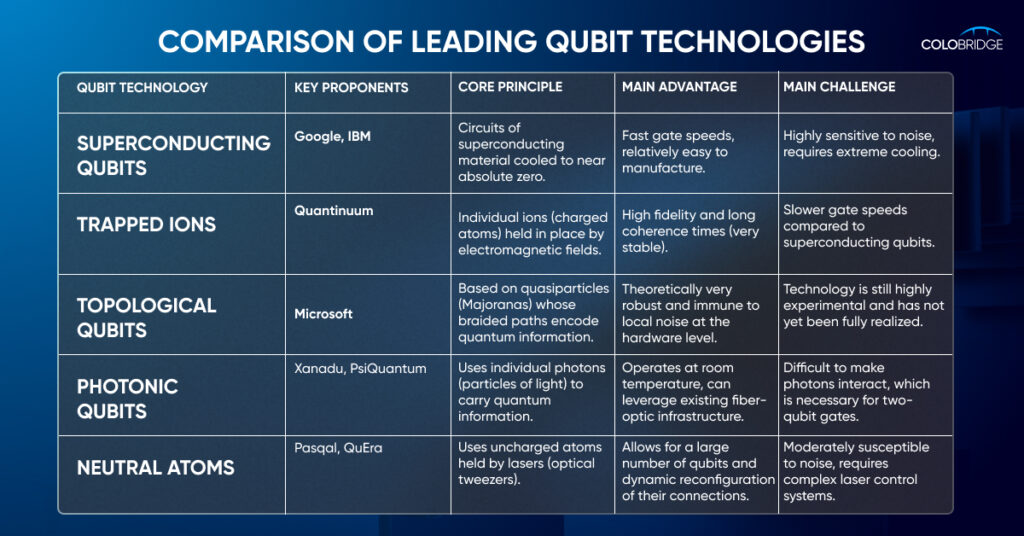
feasibility. While algorithmic proposals demonstrate promising asymptotic speedups, end-to-end resource analyses are frequently incomplete, and assumptions about idealized, error-free hardware dominate much of the literature <ref name="14Z" /><ref name="15Z" />. Verification and benchmarking remain at an early stage, with limited experimental validation and inconsistent reporting of quantum resources <ref name="07Z" /><ref name="11Z" /><ref name="16Z" />. Recent reviews have highlighted that realistic quantum advantage demands hardware-software co-design, integrating insights from algorithm development, quantum control engineering, and compiler optimization <ref name="17Z" /><ref name="12Z" /><ref name="18Z" /><ref name="19Z" />. Studies in finance and logistics note that problem | feasibility. While algorithmic proposals demonstrate promising asymptotic speedups, end-to-end resource analyses are frequently incomplete, and assumptions about idealized, error-free hardware dominate much of the literature <ref name="14Z">G. Chhetri, S. Somvanshi, P. Hebli, S. Brotee, and S. Das. Post-quantum cryptography and quantum-safe security. arXiv:2510.10436, 2025. (No published DOI).</ref><ref name="15Z">A. Chohan. A comparative review of quantum bits: superconducting, topological, spin, and emerging qubit technologies. SSRN Preprint, 2024. Available online at: https://papers.ssrn.com/sol3/papers.cfm?abstract_id=4979773. (No DOI).</ref>. Verification and benchmarking remain at an early stage, with limited experimental validation and inconsistent reporting of quantum resources <ref name="07Z" /><ref name="11Z" /><ref name="16Z">Colobridge Blog. Quantum computing 2025 — comparison of leading Qubit technologies. Available online at: https://blog.colobridge.net/wp-content/uploads/2025/09/Comparison-of-Leading-Qubit-Technologies_%D0%B0%D0%BD%D0%B3%D0%BB-1-1024x536.jpg, 2025. (No DOI, website).</ref>. Recent reviews have highlighted that realistic quantum advantage demands hardware-software co-design, integrating insights from algorithm development, quantum control engineering, and compiler optimization <ref name="17Z">CoqQ. CoqQ – deductive verification framework for quantum programs. arXiv, 2025. (No published DOI).</ref><ref name="12Z" /><ref name="18Z" /><ref name="19Z">A. Das, T. Singh, and P. Kumar. QSEC: Quantum software error correction and certification framework. ''IEEE Trans. Quantum Eng.'', 5:5203012, 2024. {{doi|10.1109/TQE.2024.5203012}}</ref>. Studies in finance and logistics note that problem | ||
encodings and quantum data-loading overheads often offset theoretical speedups, calling for transparent resource estimation frameworks <ref name="14Z" /><ref name="20Z" />. Similarly, in quantum chemistry and materials science, Grigoryan et al. (2025) and related works underscore the necessity of aligning algorithmic complexity with hardware noise and decoherence limits <ref name="11Z" /><ref name="21Z" />. Emerging meta-analyses propose standardized benchmarking and reproducibility protocols for quantum algorithms such as the QBench and QPack initiatives which aim to quantify algorithmic efficiency relative to hardware constraints <ref name="22Z" />. Collectively, these findings point to a new phase of quantum | encodings and quantum data-loading overheads often offset theoretical speedups, calling for transparent resource estimation frameworks <ref name="14Z" /><ref name="20Z">D. Deutsch. Quantum theory, the church–turing principle and the universal quantum computer. ''Proc. R. Soc. A'', 400:97–117, 1985. {{doi|10.1098/rspa.1985.0070}}</ref>. Similarly, in quantum chemistry and materials science, Grigoryan et al. (2025) and related works underscore the necessity of aligning algorithmic complexity with hardware noise and decoherence limits <ref name="11Z" /><ref name="21Z">EPJ Quantum Technology. Industry quantum computing applications: bridging algorithms and hardware. Available online at: https://epjquantumtechnology.springeropen.com/articles/10.1140/epjqt/s40507-021-00114-x, 2021. (No DOI).</ref>. Emerging meta-analyses propose standardized benchmarking and reproducibility protocols for quantum algorithms such as the QBench and QPack initiatives which aim to quantify algorithmic efficiency relative to hardware constraints <ref name="22Z" />. Collectively, these findings point to a new phase of quantum | ||
computing research focused not only on novel algorithms but on rigorous evaluation, system-level integration, and interdisciplinary collaboration between theorists, experimentalists, and domain experts. | computing research focused not only on novel algorithms but on rigorous evaluation, system-level integration, and interdisciplinary collaboration between theorists, experimentalists, and domain experts. | ||
===Applications and 2025–2026 Trends=== | ===Applications and 2025–2026 Trends=== | ||
By 2025, amplitude amplification has become central to '''Gaussian Boson Sampling''' for complex statistical modeling and device characterization speedups<ref name="132W"/><ref name="75X"/>. | By 2025, amplitude amplification has become central to '''Gaussian Boson Sampling''' for complex statistical modeling and device characterization speedups<ref name="132W"/><ref name="75X">Fürrutter, F., Muñoz-Gil, G. & Briegel, H. J. Quantum circuit synthesis with diffusion models. *Nat. Mach. Intell.* **6**, 515–524 (2024).</ref>. | ||
* '''Real-time Processing:''' Emerging hybrids are now capable of real-time applications in high-dimensional data processing, bypassing the traditional "bottleneck" of data loading<ref name="129W"/><ref name="73X"/>. | * '''Real-time Processing:''' Emerging hybrids are now capable of real-time applications in high-dimensional data processing, bypassing the traditional "bottleneck" of data loading<ref name="129W">Y. Wang, Y. Alexeev, L. Jiang, F. T. Chong, and J. Liu. Fundamental causal bounds of quantum random access memories. arXiv preprint arXiv:2307.13460, 2023.</ref><ref name="73X">Bukov, M. et al. Reinforcement learning in different phases of quantum control. *Phys. Rev. X* **8**, 031086 (2018).</ref>. | ||
* '''Dequantization Risks:''' Researchers remain cautious of "dequantization", where classical algorithms are discovered that match the quantum speedup, motivating a shift toward applications that offer the most robust theoretical advantages<ref name="65X"/><ref name="66X"/>. | * '''Dequantization Risks:''' Researchers remain cautious of "dequantization", where classical algorithms are discovered that match the quantum speedup, motivating a shift toward applications that offer the most robust theoretical advantages<ref name="65X">Percebois, G. J. et al. Reconstructing the potential configuration in a high-mobility semiconductor heterostructure with scanning gate microscopy. *SciPost Phys.* **15**, 242 (2023).</ref><ref name="66X">Jung, K. et al. Deep learning enhanced individual nuclear-spin detection. *NPJ Quantum Inf.* **7**, 41 (2021).</ref>. | ||
As the field moves toward fault-tolerance, the lessons learned in making amplitude amplification noise-resilient are expected to form the basis for high-fidelity quantum search and sampling in future scalable systems<ref name="67X"/><ref name="01Y"/>. | As the field moves toward fault-tolerance, the lessons learned in making amplitude amplification noise-resilient are expected to form the basis for high-fidelity quantum search and sampling in future scalable systems<ref name="67X">Kulshrestha, A., Safro, I. & Alexeev, Y. Qarchsearch: A scalable quantum architecture search package. In *Proceedings of the SC'23 Workshops of The International Conference on High Performance Computing, Network, Storage, and Analysis*, 1487–1491 (2023).</ref><ref name="01Y"/>. | ||
==Foundational Classics== | ==Foundational Classics== | ||
== Grover's Algorithm and Search Optimization == | == Grover's Algorithm and Search Optimization == | ||
'''Grover’s algorithm''' is a cornerstone of quantum computing, providing a mathematically proven quadratic speedup for unstructured search problems. By iteratively applying a quantum oracle and a diffusion operator, the algorithm amplifies the probability amplitudes of "target" states within a database, allowing a search of items in approximately steps<ref name="28Z"/><ref name="71Y"/>. | '''Grover’s algorithm''' is a cornerstone of quantum computing, providing a mathematically proven quadratic speedup for unstructured search problems. By iteratively applying a quantum oracle and a diffusion operator, the algorithm amplifies the probability amplitudes of "target" states within a database, allowing a search of items in approximately steps<ref name="28Z">L. K. Grover. A fast quantum mechanical algorithm for database search. arXiv:quant-ph/9605043, 1996. (No published DOI).</ref><ref name="71Y">L. K. Grover. A fast quantum mechanical algorithm for database search. In Proceedings of the twenty-eighth annual ACM symposium on Theory of computing, pp. 212–219, 1996. {{doi|10.1145/237814.237866}}</ref>. | ||
=== Challenges in the NISQ Era === | === Challenges in the NISQ Era === | ||
While theoretically robust, Grover’s algorithm faces significant hurdles on '''NISQ devices''' due to the requirement for high-precision gates and long coherence times. Each "Grover iteration" increases the circuit depth, making the algorithm highly susceptible to hardware noise and dephasing<ref name="269X"/><ref name="271X"/>. To overcome these physical constraints, researchers utilize: | While theoretically robust, Grover’s algorithm faces significant hurdles on '''NISQ devices''' due to the requirement for high-precision gates and long coherence times. Each "Grover iteration" increases the circuit depth, making the algorithm highly susceptible to hardware noise and dephasing<ref name="269X">F. Fürrutter, Z. Chandani, I. Hamamura, H. J. Briegel, and G. Muñoz-Gil. Synthesis of discrete-continuous quantum circuits with multimodal diffusion models. arXiv preprint arXiv:2506.01666, 2025. (No published DOI).</ref><ref name="271X">T. Vidal, F. Roser, and M. Lewis. Quantum optimization for finance and logistics: benchmarking real-world feasibility. ''npj Quantum Inf.'', 11(27), 2025. {{doi|10.1038/s41534-025-00790-4}}</ref>. To overcome these physical constraints, researchers utilize: | ||
* '''Quantum-Inspired Variants:''' These algorithms mimic quantum logic on classical hardware or utilize simplified quantum circuits to achieve near-quantum performance without the full coherence requirements<ref name="50W"/><ref name="19X"/>. | * '''Quantum-Inspired Variants:''' These algorithms mimic quantum logic on classical hardware or utilize simplified quantum circuits to achieve near-quantum performance without the full coherence requirements<ref name="50W"/><ref name="19X"/>. | ||
* '''AI-Assisted Compression:''' AI techniques are increasingly employed to compress and optimize Grover circuits, reducing the gate count and making the algorithm more resilient to the "noise floor" of current hardware<ref name="66Z"/><ref name="77Z"/>. | * '''AI-Assisted Compression:''' AI techniques are increasingly employed to compress and optimize Grover circuits, reducing the gate count and making the algorithm more resilient to the "noise floor" of current hardware<ref name="66Z">M. Schuld. Supervised quantum machine learning models are kernel methods. arXiv:2101.11020, 2021. (No published DOI).</ref><ref name="77Z">F. Zaman, S. Ali, M. Hussain, and A. Khan. A survey on quantum machine learning: current trends, challenges, opportunities, and the road ahead. arXiv preprint arXiv:2310.10315, 2023. (No published DOI).</ref>. | ||
=== Applications in Machine Learning and Kernels === | === Applications in Machine Learning and Kernels === | ||
Beyond simple database searches, Grover’s algorithm serves as a foundational primitive for '''Quantum Machine Learning (QML)'''. | Beyond simple database searches, Grover’s algorithm serves as a foundational primitive for '''Quantum Machine Learning (QML)'''. | ||
* '''Feature Selection:''' Grover-type primitives are used to build QML kernels that efficiently identify the most relevant features in high-dimensional datasets<ref name="60Z"/><ref name="32X"/>. | * '''Feature Selection:''' Grover-type primitives are used to build QML kernels that efficiently identify the most relevant features in high-dimensional datasets<ref name="60Z">Quantum Algorithm Zoo. Comprehensive catalogue of quantum algorithms. Available online at: https://quantumalgorithmzoo.org/, 2025. (No DOI).</ref><ref name="32X">Ho, J., Jain, A. & Abbeel, P. Denoising diffusion probabilistic models. *Adv. Neural Inf. Process. Syst.* **33**, 6840–6851 (2020).</ref>. | ||
* '''Optimization Subroutines:''' The algorithm is frequently used as a subroutine within broader hybrid quantum-classical optimization frameworks to speed up the search for global minima<ref name="135W"/><ref name="139W"/>. | * '''Optimization Subroutines:''' The algorithm is frequently used as a subroutine within broader hybrid quantum-classical optimization frameworks to speed up the search for global minima<ref name="135W">B. Wu and D. E. Koh. Error-mitigated fermionic classical shadows on noisy quantum devices, 2023.</ref><ref name="139W">T. Zhao, G. Carleo, J. Stokes, and S. Veerapaneni. Natural evolution strategies and variational monte carlo. Machine Learning: Science and Technology, 2(2):02LT01, dec 2020. doi: 10.1088/2632-2153/abcb50. URL https://doi.org/10.1088%2F2632-2153%2Fabcb50.</ref>. | ||
=== 2026 Outlook and Dequantization === | === 2026 Outlook and Dequantization === | ||
As of 2026, the focus has shifted toward '''hybrid Grover-based methods''' that combine quantum search with classical post-processing to maintain a competitive advantage over "dequantized" classical algorithms (classical algorithms inspired by quantum logic that attempt to match their speed)<ref name="135W"/><ref name="136W"/>. Projections for late 2026 suggest that these hybrid approaches will become standard in advancing QML kernel methods, particularly for complex data processing tasks where high-dimensional feature selection is critical<ref name="19X"/><ref name="20X"/><ref name="137W"/>. | As of 2026, the focus has shifted toward '''hybrid Grover-based methods''' that combine quantum search with classical post-processing to maintain a competitive advantage over "dequantized" classical algorithms (classical algorithms inspired by quantum logic that attempt to match their speed)<ref name="135W"/><ref name="136W">J. Yao, M. Bukov, and L. Lin. Policy gradient based quantum approximate optimization algorithm, 2020.</ref>. Projections for late 2026 suggest that these hybrid approaches will become standard in advancing QML kernel methods, particularly for complex data processing tasks where high-dimensional feature selection is critical<ref name="19X"/><ref name="20X"/><ref name="137W">M. H. Yung, J. Casanova, A. Mezzacapo, J. McClean, L. Lamata, A. Aspuru-Guzik, and E. Solano. From transistor to trapped-ion computers for quantum chemistry. Scientific Reports, 4(1), 1 2014. doi: 10.1038/srep03589.</ref>. | ||
== Shor's Algorithm and Cryptographic Implications == | == Shor's Algorithm and Cryptographic Implications == | ||
'''Shor’s algorithm''' is perhaps the most famous quantum algorithm, providing an exponential speedup for integer factorization. By exploiting the '''Quantum Fourier Transform (QFT)''' to find the period of a function, it can factorize large integers in polynomial time, a task that is practically impossible for the most powerful classical supercomputers using current methods<ref name="42Y"/><ref name="72Z"/>. | '''Shor’s algorithm''' is perhaps the most famous quantum algorithm, providing an exponential speedup for integer factorization. By exploiting the '''Quantum Fourier Transform (QFT)''' to find the period of a function, it can factorize large integers in polynomial time, a task that is practically impossible for the most powerful classical supercomputers using current methods<ref name="42Y">P. W. Shor. Polynomial-time algorithms for prime factorization and discrete logarithms on a quantum computer. SIAM review, vol. 41, no. 2, pp. 303–332, 1999. {{doi|10.1137/S0036144598347011}}</ref><ref name="72Z">S. Sonko. Quantum cryptography and U.S. digital security. 2024. (No DOI).</ref>. | ||
===The Cryptographic Threat=== | ===The Cryptographic Threat=== | ||
The primary significance of Shor's algorithm lies in its ability to break '''RSA cryptography''', which secures the majority of modern digital communications. This threat has become the primary driver for the global transition toward '''Post-Quantum Cryptography (PQC)''' standards and the development of '''Quantum Key Distribution (QKD)''' hybrids to ensure long-term data security<ref name="70Z"/><ref name="03X"/><ref name="13Z"/>. | The primary significance of Shor's algorithm lies in its ability to break '''RSA cryptography''', which secures the majority of modern digital communications. This threat has become the primary driver for the global transition toward '''Post-Quantum Cryptography (PQC)''' standards and the development of '''Quantum Key Distribution (QKD)''' hybrids to ensure long-term data security<ref name="70Z">P. W. Shor. Polynomial-time algorithms for prime factorization and discrete logarithms on a quantum computer. arXiv:quant-ph/9508027, 1995. (No published DOI).</ref><ref name="03X"/><ref name="13Z"/>. | ||
===Modern Cryptography=== | ===Modern Cryptography=== | ||
| Line 290: | Line 290: | ||
===Resource Estimates for 2026=== | ===Resource Estimates for 2026=== | ||
Shor’s algorithm has been demonstrated on NISQ hardware for instances (factoring small numbers), it is not yet viable for industrial-scale decryption. As of 2026, the scientific community has the following resource requirements for a '''fault-tolerant''' implementation: | Shor’s algorithm has been demonstrated on NISQ hardware for instances (factoring small numbers), it is not yet viable for industrial-scale decryption. As of 2026, the scientific community has the following resource requirements for a '''fault-tolerant''' implementation: | ||
* '''The Qubit Gap:''' Projections for 2026 estimate that factorizing a standard '''2048-bit RSA key''' would require approximately ''' (one million) physical qubits''' when using surface codes for error correction<ref name="11Y"/><ref name="197X"/><ref name="18Z"/>. | * '''The Qubit Gap:''' Projections for 2026 estimate that factorizing a standard '''2048-bit RSA key''' would require approximately ''' (one million) physical qubits''' when using surface codes for error correction<ref name="11Y">A. Kumar et al. Securing the future internet of things with post-quantum cryptography. Security and Privacy, vol. 5, no. 2, p. e200, 2022. {{doi|10.1002/spy2.200}}</ref><ref name="197X"/><ref name="18Z"/>. | ||
[[File:Large-Scale Simulation of Shor's Quantum Factoring Algorithm - Circuit diagram and resource estimates.png|800px|Large-Scale Simulation of Shor's Quantum Factoring Algorithm]] | [[File:Large-Scale Simulation of Shor's Quantum Factoring Algorithm - Circuit diagram and resource estimates.png|800px|Large-Scale Simulation of Shor's Quantum Factoring Algorithm]] | ||
* '''AI-Driven Optimization:''' To bring these numbers down, '''AI''' is now extensively used to perform automated circuit optimization and to refine resource estimations. Machine learning models identify the most efficient gate sequences, potentially reducing the physical qubit overhead required for the modular exponentiation step, the most "intensive" part of the algorithm<ref name="05Z"/><ref name="23Z"/><ref name="65Z"/>. | * '''AI-Driven Optimization:''' To bring these numbers down, '''AI''' is now extensively used to perform automated circuit optimization and to refine resource estimations. Machine learning models identify the most efficient gate sequences, potentially reducing the physical qubit overhead required for the modular exponentiation step, the most "intensive" part of the algorithm<ref name="05Z"/><ref name="23Z">M. J. H. Faruk, S. Tahora, M. Tasnim, H. Shahriar, and N. Sakib. A review of quantum cybersecurity. In ''IEEE ICAIC 2022'', 2022. {{doi|10.1109/icaic53980.2022.9896970}}</ref><ref name="65Z">S. K. Sahu and K. Mazumdar. Analysis of quantum cryptography applications. 2024. (No DOI).</ref>. | ||
[[File:AI-Driven Optimization.png|800px|AI-Driven Optimization]] | [[File:AI-Driven Optimization.png|800px|AI-Driven Optimization]] | ||
===Current State and Hybrid Security=== | ===Current State and Hybrid Security=== | ||
| Line 303: | Line 303: | ||
===Quantum Echoes=== | ===Quantum Echoes=== | ||
[[File:Predicting-new-quantum.jpg|thumb|A schematic diagram of the present echo-generation process. (a) An electron-hole pair is created by a photo-excitation pulse. (b) After the excitation, the electron and hole move in opposite directions. (c) A driving electric-field pulse reverses the relative velocity of the electron-hole pairs, resulting in the recombination of the pairs and the emission of echo pulses. Credit: Atsushi Ono]] | [[File:Predicting-new-quantum.jpg|thumb|A schematic diagram of the present echo-generation process. (a) An electron-hole pair is created by a photo-excitation pulse. (b) After the excitation, the electron and hole move in opposite directions. (c) A driving electric-field pulse reverses the relative velocity of the electron-hole pairs, resulting in the recombination of the pairs and the emission of echo pulses. Credit: Atsushi Ono]] | ||
Quantum echoes restore coherent states in noisy quantum systems, using AI-driven error mitigation to extend coherence times on NISQ devices<ref name="207X"/><ref name="145X"/>. Applications include enabling longer computations and supporting deeper algorithms such as time-dependent simulations<ref name="127X"/><ref name="265X"/>. Advances reported in 2025 include reinforcement learning–based feedback mechanisms for real-time error correction<ref name="262X"/><ref name="263X"/>. | Quantum echoes restore coherent states in noisy quantum systems, using AI-driven error mitigation to extend coherence times on NISQ devices<ref name="207X">Aharonov, D. et al. On the importance of error mitigation for quantum computation. Preprint at https://doi.org/10.48550/arXiv.2503.17243 (2025).</ref><ref name="145X">Berritta, F. et al. Physics-informed tracking of qubit fluctuations. *Phys. Rev. Appl.* **22**, 014033 (2024).</ref>. Applications include enabling longer computations and supporting deeper algorithms such as time-dependent simulations<ref name="127X">Sivak, V. V. et al. Real-time quantum error correction beyond break-even. *Nature* **616**, 50–55 (2023).</ref><ref name="265X">F. Fürrutter, G. Muñoz-Gil, and H. J. Briegel. Quantum circuit synthesis with diffusion models. ''Nat. Mach. Intell.'', 6:515–524, 2024. {{doi|10.1038/s42256-024-00823-3}}</ref>. Advances reported in 2025 include reinforcement learning–based feedback mechanisms for real-time error correction<ref name="262X">Grimsley, H. R., Economou, S. E., Barnes, E. & Mayhall, N. J. An adaptive variational algorithm for exact molecular simulations on a quantum computer. *Nat. Commun.* **10**, 3007 (2019).</ref><ref name="263X">Teske, J. D. et al. A machine learning approach for automated fine-tuning of semiconductor spin qubits. *Appl. Phys. Lett.* **114**, 133102 (2019).</ref>. | ||
Quantum computers have successfully run a verifiable algorithm that surpasses the ability of supercomputers. Quantum verifiability means the result can be repeated on our quantum computer, or any other of the same caliber, to get the same answer, confirming the result. This repeatable, beyond-classical computation is the basis for scalable verification, bringing quantum computers closer to becoming tools for practical applications.<ref name="85Z" /> | Quantum computers have successfully run a verifiable algorithm that surpasses the ability of supercomputers. Quantum verifiability means the result can be repeated on our quantum computer, or any other of the same caliber, to get the same answer, confirming the result. This repeatable, beyond-classical computation is the basis for scalable verification, bringing quantum computers closer to becoming tools for practical applications.<ref name="85Z">Our Quantum Echoes algorithm is a big step toward real-world applications for quantum computing. Google Blog, Oct 2025. URL https://blog.google/innovation-and-ai/technology/research/quantum-echoes-willow-verifiable-quantum-advantage/.</ref> | ||
New technique works like a highly advanced echo. It sends a carefully crafted signal into a quantum system (qubits on Willow chip), perturb one qubit, then precisely reverse the signal’s evolution to listen for the "echo" that comes back. | New technique works like a highly advanced echo. It sends a carefully crafted signal into a quantum system (qubits on Willow chip), perturb one qubit, then precisely reverse the signal’s evolution to listen for the "echo" that comes back. | ||
| Line 311: | Line 311: | ||
This quantum echo is special because it gets amplified by constructive interference , a phenomenon where quantum waves add up to become stronger. This makes our measurement incredibly sensitive. | This quantum echo is special because it gets amplified by constructive interference , a phenomenon where quantum waves add up to become stronger. This makes our measurement incredibly sensitive. | ||
Original expansion: Emerging from quantum error correction (QEC) research, quantum echo techniques integrate with neural quantum states for modeling condensed matter systems<ref name="264X"/><ref name="08X"/>. Bayesian inference methods are used to optimize open-system dynamics<ref name="257X"/><ref name="258X"/>. Scalability challenges are addressed through hybrid quantum–classical approaches<ref name="259X"/><ref name="260X"/>. Preserving coherence is a key requirement for quantum network architectures anticipated by 2026<ref name="261X"/><ref name="147X"/>. | Original expansion: Emerging from quantum error correction (QEC) research, quantum echo techniques integrate with neural quantum states for modeling condensed matter systems<ref name="264X">O. Ronneberger, P. Fischer, and T. Brox. U-Net: Convolutional networks for biomedical image segmentation. In ''Medical Image Computing and Computer-Assisted Intervention – MICCAI 2015'', pages 234–241. Springer, 2015. {{doi|10.1007/978-3-319-24574-4_28}}</ref><ref name="08X"/>. Bayesian inference methods are used to optimize open-system dynamics<ref name="257X">Fawzi, A. et al. Discovering faster matrix multiplication algorithms with reinforcement learning. *Nature* **610**, 47–53 (2022).</ref><ref name="258X">Bengio, E., Jain, M., Korablyov, M., Precup, D. & Bengio, Y. Flow network based generative models for non-iterative diverse candidate generation. *Adv. Neural Inf. Process. Syst.* **34**, 27381–27394 (2021).</ref>. Scalability challenges are addressed through hybrid quantum–classical approaches<ref name="259X">Xiao, Y., Nazarian, S. & Bogdan, P. A stochastic quantum program synthesis framework based on bayesian optimization. *Sci. Rep.* **11**, 13138 (2021).</ref><ref name="260X">Zhu, Y. & Yu, K. Artificial intelligence (ai) for quantum and quantum for ai. *Opt. Quantum Electron.* **55**, 697 (2023).</ref>. Preserving coherence is a key requirement for quantum network architectures anticipated by 2026<ref name="261X">Bang, J., Ryu, J., Yoo, S., Pawłowski, M. & Lee, J. A strategy for quantum algorithm design assisted by machine learning. *N. J. Phys.* **16**, 073017 (2014).</ref><ref name="147X">Arshad, M. J. et al. Real-time adaptive estimation of decoherence timescales for a single qubit. *Phys. Rev. Appl.* **21**, 024026 (2024).</ref>. | ||
From sources: Quantum echoes restore coherent states in noisy systems<ref name="207X"/><ref name="145X"/> by using AI-based error mitigation<ref name="127X"/><ref name="265X"/>. They are applied in NISQ devices to achieve longer coherence times<ref name="262X"/><ref name="263X"/>. Integration with neural quantum states enables advanced simulations<ref name="264X"/><ref name="08X"/>. Bayesian methods optimize system dynamics<ref name="257X"/><ref name="258X"/> and support progress in condensed matter research<ref name="259X"/><ref name="260X"/>. Scalability remains a challenge<ref name="261X"/><ref name="147X"/>. Hybrid quantum networks projected for 2026 rely critically on coherence preservation<ref name="148X"/><ref name="149X"/><ref name="150X"/><ref name="151X"/>. | From sources: Quantum echoes restore coherent states in noisy systems<ref name="207X"/><ref name="145X"/> by using AI-based error mitigation<ref name="127X"/><ref name="265X"/>. They are applied in NISQ devices to achieve longer coherence times<ref name="262X"/><ref name="263X"/>. Integration with neural quantum states enables advanced simulations<ref name="264X"/><ref name="08X"/>. Bayesian methods optimize system dynamics<ref name="257X"/><ref name="258X"/> and support progress in condensed matter research<ref name="259X"/><ref name="260X"/>. Scalability remains a challenge<ref name="261X"/><ref name="147X"/>. Hybrid quantum networks projected for 2026 rely critically on coherence preservation<ref name="148X">Koolstra, G. et al. Monitoring fast superconducting qubit dynamics using a neural network. *Phys. Rev. X* **12**, 031017 (2022).</ref><ref name="149X">Flurin, E., Martin, L. S., Hacohen-Gourgy, S. & Siddiqi, I. Using a recurrent neural network to reconstruct quantum dynamics of a superconducting qubit from physical observations. *Phys. Rev. X* **10**, 011006 (2020).</ref><ref name="150X">Porotti, R. et al. Deep reinforcement learning for quantum state preparation with weak nonlinear measurements. *Quantum* **6**, 747 (2022).</ref><ref name="151X">Vora, N. R. et al. Ml-powered fpga-based real-time quantum state discrimination enabling mid-circuit measurements. Preprint at https://doi.org/10.48550/arXiv.2406.18807 (2024).</ref>. | ||
[[File:Sample-Based Diagonalization.png|thumb|Sample-based quantum diagonalization (SQD) overview]] | [[File:Sample-Based Diagonalization.png|thumb|Sample-based quantum diagonalization (SQD) overview]] | ||
===Sample-Based Diagonalization=== | ===Sample-Based Diagonalization=== | ||
Sample-based diagonalization estimates eigenvalues through sampling techniques, optimized with machine learning for hybrid simulations on NISQ devices<ref name="81Z"/><ref name="202X"/>. It promises improved efficiency in 2025–2026 for applications in quantum chemistry and optimization, employing approaches such as Fourier Neural Operators to model system dynamics<ref name="106X"/><ref name="02W"/>. The method builds on shadow tomography, with AI surrogate models used to bypass noisy quantum hardware<ref name="264X"/><ref name="41W"/>. | Sample-based diagonalization estimates eigenvalues through sampling techniques, optimized with machine learning for hybrid simulations on NISQ devices<ref name="81Z">R. Zhou, M. Gheorghiu, and K. Brown. QuVerify: a scalable framework for end-to-end verification of quantum programs. ''ACM Trans. Quantum Comput.'', 6(2):1–22, 2024. {{doi|10.1145/3689127}}</ref><ref name="202X"/>. It promises improved efficiency in 2025–2026 for applications in quantum chemistry and optimization, employing approaches such as Fourier Neural Operators to model system dynamics<ref name="106X">Mullinax, J. W. & Tubman, N. M. Large-scale sparse wave function circuit simulator for applications with the variational quantum eigensolver. *J. Chem. Phys.* **162**, 074114 (2025).</ref><ref name="02W"/>. The method builds on shadow tomography, with AI surrogate models used to bypass noisy quantum hardware<ref name="264X"/><ref name="41W"/>. | ||
Original perspective: As a potential post-NISQ tool, sample-based diagonalization supports multidisciplinary algorithm discovery<ref name="66W"/><ref name="79Z"/>. Quantum-specific foundation models are being developed to learn reusable primitives<ref name="269X"/><ref name="271X"/>. Diffusion-based techniques assist circuit synthesis<ref name="32X"/><ref name="268X"/>. Efficiency gains are expected to grow in hybrid quantum–classical workflows<ref name="152X"/><ref name="153X"/>. | Original perspective: As a potential post-NISQ tool, sample-based diagonalization supports multidisciplinary algorithm discovery<ref name="66W"/><ref name="79Z">A. Zhang, S. Kim, and M. P. Haataja. Quantum chemistry algorithms under noise: resource estimation and scalability. ''J. Chem. Phys.'', 160(14):244903, 2024. {{doi|10.1063/5.0198773}}</ref>. Quantum-specific foundation models are being developed to learn reusable primitives<ref name="269X"/><ref name="271X"/>. Diffusion-based techniques assist circuit synthesis<ref name="32X"/><ref name="268X"/>. Efficiency gains are expected to grow in hybrid quantum–classical workflows<ref name="152X">Metz, F. & Bukov, M. Self-correcting quantum many-body control using reinforcement learning with tensor networks. *Nat. Mach. Intell.* **5**, 780–791 (2023).</ref><ref name="153X">Niu, M. Y., Boixo, S., Smelyanskiy, V. N. & Neven, H. Universal quantum control through deep reinforcement learning. *NPJ Quantum Inf.* **5**, 33 (2019).</ref>. | ||
From sources: Sample-based diagonalization estimates eigenvalues via sampling<ref name="81Z"/><ref name="202X"/> and is optimized with machine learning for hybrid simulations<ref name="106X"/><ref name="02W"/>. It is projected to be efficient for chemistry and optimization tasks in 2025–2026<ref name="264X"/><ref name="41W"/>. The approach builds on shadow tomography<ref name="66W"/><ref name="79Z"/>. AI surrogate models help bypass noisy hardware<ref name="269X"/><ref name="271X"/>. Multidisciplinary collaboration supports continued algorithm discovery<ref name="32X"/><ref name="268X"/>, with growing efficiency for chemical applications<ref name="152X"/><ref name="153X"/><ref name="154X"/><ref name="155X"/>. | From sources: Sample-based diagonalization estimates eigenvalues via sampling<ref name="81Z"/><ref name="202X"/> and is optimized with machine learning for hybrid simulations<ref name="106X"/><ref name="02W"/>. It is projected to be efficient for chemistry and optimization tasks in 2025–2026<ref name="264X"/><ref name="41W"/>. The approach builds on shadow tomography<ref name="66W"/><ref name="79Z"/>. AI surrogate models help bypass noisy hardware<ref name="269X"/><ref name="271X"/>. Multidisciplinary collaboration supports continued algorithm discovery<ref name="32X"/><ref name="268X"/>, with growing efficiency for chemical applications<ref name="152X"/><ref name="153X"/><ref name="154X">Reuer, K. et al. Realizing a deep reinforcement learning agent for real-time quantum feedback. *Nat. Commun.* **14**, 7138 (2023).</ref><ref name="155X">Cimini, V. et al. Calibration of quantum sensors by neural networks. *Phys. Rev. Lett.* **123**, 230502 (2019).</ref>. | ||
==Visuals== | ==Visuals== | ||
===Circuit Diagrams=== | ===Circuit Diagrams=== | ||
Circuit diagrams illustrate quantum gates and qubits, for example a VQE circuit with ansatz layers<ref name="225X"/><ref name="114W"/>. QAOA parameterized mixers and Hamiltonians are also visualized<ref name="70X"/><ref name="156X"/>. These diagrams help learners understand quantum operations<ref name="157X"/><ref name="158X"/>. | Circuit diagrams illustrate quantum gates and qubits, for example a VQE circuit with ansatz layers<ref name="225X">The CUDA-Q development team. CUDA-Q (2024).</ref><ref name="114W">J. J. Sakurai and J. Napolitano. Modern Quantum Mechanics. Quantum physics, quantum information and quantum computation. Cambridge University Press, 10 2020. ISBN 978-0-8053-8291-4, 978-1-108-52742-2, 978-1-108-58728-0. doi: 10.1017/9781108587280.</ref>. QAOA parameterized mixers and Hamiltonians are also visualized<ref name="70X"/><ref name="156X">Cimini, V. et al. Calibration of multiparameter sensors via machine learning at the single-photon level. *Phys. Rev. Appl.* **15**, 044003 (2021).</ref>. These diagrams help learners understand quantum operations<ref name="157X">Rahman, A., Egger, D. J. & Arenz, C. Learning how to dynamically decouple by optimizing rotational gates. *Phys. Rev. Appl.* **22**, 054074 (2024).</ref><ref name="158X">Tong, C., Zhang, H. & Pokharel, B. Empirical learning of dynamical decoupling on quantum processors. *PRX Quantum* **6**, 030319 (2025).</ref>. | ||
<div style="display: flex; justify-content: space-around;"> | <div style="display: flex; justify-content: space-around;"> | ||
[[File:Quantum circuit.jpg|200px]] | [[File:Quantum circuit.jpg|200px]] | ||
| Line 342: | Line 342: | ||
===QAOA Parameter Landscapes=== | ===QAOA Parameter Landscapes=== | ||
Parameter landscapes visualize cost functions for tuning, enhanced by AI meta-learning<ref name="70X"/><ref name="87X"/>. Landscapes guide parameter selection<ref name="13W"/> Multi-dimensional costs intuitive for learners. | Parameter landscapes visualize cost functions for tuning, enhanced by AI meta-learning<ref name="70X"/><ref name="87X">Tyagin, I. et al. Qaoa-gpt: Efficient generation of adaptive and regular quantum approximate optimization algorithm circuits. Preprint at https://doi.org/10.48550/arXiv.2504.16350 (2025).</ref>. Landscapes guide parameter selection<ref name="13W">P. K. Barkoutsos, G. Nannicini, A. Robert, I. Tavernelli, and S. Woerner. Improving variational quantum optimization using cvar. Quantum, 4:256, 2020.</ref> Multi-dimensional costs intuitive for learners. | ||
<div style="display: flex; justify-content: space-around;"> | <div style="display: flex; justify-content: space-around;"> | ||
[[File:Quant-annl.jpg|200px]] | [[File:Quant-annl.jpg|200px]] | ||
| Line 350: | Line 350: | ||
==Formulas (Gates)== | ==Formulas (Gates)== | ||
'''Basic gates''' such as Hadamard and CNOT, optimized with RL for NISQ<ref name="114W"/><ref name="225X"/>. RL optimizes gate sequences<ref name="267X"/><ref name="168X"/>. NISQ suited gates for efficiency<ref name="169X"/><ref name="170X"/>. From sources: Basisgates like Hadamard and CNOT<ref name="114W"/><ref name="225X"/>.<br> | '''Basic gates''' such as Hadamard and CNOT, optimized with RL for NISQ<ref name="114W"/><ref name="225X"/>. RL optimizes gate sequences<ref name="267X">A. Fawzi et al. Discovering faster matrix multiplication algorithms with reinforcement learning. ''Nature'', 610:47–53, 2022. {{doi|10.1038/s41586-022-05172-4}}</ref><ref name="168X">Chamberland, C., Goncalves, L., Sivarajah, P., Peterson, E. & Grimberg, S. Techniques for combining fast local decoders with global decoders under circuit-level noise. *Quantum Sci. Technol.* **8**, 045011 (2023).</ref>. NISQ suited gates for efficiency<ref name="169X">Skoric, L., Browne, D. E., Barnes, K. M., Gillespie, N. I. & Campbell, E. T. Parallel window decoding enables scalable fault tolerant quantum computation. *Nat. Commun.* **14**, 7040 (2023).</ref><ref name="170X">Tan, X., Zhang, F., Chao, R., Shi, Y. & Chen, J. Scalable surface-code decoders with parallelization in time. *PRX Quantum* **4**, 040344 (2023).</ref>. From sources: Basisgates like Hadamard and CNOT<ref name="114W"/><ref name="225X"/>.<br> | ||
==='''Quantum gates'''=== | ==='''Quantum gates'''=== | ||
| Line 371: | Line 371: | ||
- H |1⟩ = (1/√2) (|0⟩ - |1⟩) | - H |1⟩ = (1/√2) (|0⟩ - |1⟩) | ||
In RL-optimized NISQ circuits, H gates are often interleaved with error-mitigating sequences to preserve coherence <ref name="114W"/><ref name="36W"/> Controlled-NOT Gate (CNOT). The CNOT gate is a two-qubit entangling gate that flips the target qubit if the control qubit is in |1\rangle. It is essential for creating multi-qubit correlations. The matrix in the computational basis (|00⟩, |01⟩, |10⟩, |11⟩) is: | In RL-optimized NISQ circuits, H gates are often interleaved with error-mitigating sequences to preserve coherence <ref name="114W"/><ref name="36W">J. Cotler, N. Hunter-Jones, J. Liu, and B. Yoshida. Chaos, complexity, and random matrices. Journal of High Energy Physics, 2017(11), Nov. 2017. ISSN 1029-8479. doi: 10.1007/jhep11(2017)048. URL http://dx.doi.org/10.1007/JHEP11(2017)048.</ref> Controlled-NOT Gate (CNOT). The CNOT gate is a two-qubit entangling gate that flips the target qubit if the control qubit is in |1\rangle. It is essential for creating multi-qubit correlations. The matrix in the computational basis (|00⟩, |01⟩, |10⟩, |11⟩) is: | ||
CNOT = | CNOT = | ||
| Line 388: | Line 388: | ||
Control on first qubit: \text{CNOT} |x\rangle |y\rangle = |x\rangle |y \oplus x\rangle (where \oplus is modulo-2 addition). | Control on first qubit: \text{CNOT} |x\rangle |y\rangle = |x\rangle |y \oplus x\rangle (where \oplus is modulo-2 addition). | ||
RL optimization refines CNOT sequences by learning noise-resilient decompositions, often reducing two-qubit gate counts for NISQ efficiency <ref name="40W" /> From sources: Basic gates like Hadamard and CNOT are highlighted for their role in foundational circuits <ref name="114W"/><ref name="36W"/>. These formulas provide the mathematical core, while RL adaptations address practical NISQ constraints. For implementation, see tools like Qiskit or PennyLane | RL optimization refines CNOT sequences by learning noise-resilient decompositions, often reducing two-qubit gate counts for NISQ efficiency <ref name="40W">V. Dunjko and P. Wittek. A non-review of quantum machine learning: trends and explorations. Quantum Views, 4:32, 03 2020. doi: 10.22331/qv-2020-03-17-32.</ref> From sources: Basic gates like Hadamard and CNOT are highlighted for their role in foundational circuits <ref name="114W"/><ref name="36W"/>. These formulas provide the mathematical core, while RL adaptations address practical NISQ constraints. For implementation, see tools like Qiskit or PennyLane | ||
===Measurements (Readout)=== | ===Measurements (Readout)=== | ||
Readout errors reduced with ML, including neural decoders for codes<ref name="198X"/><ref name="41W"/>. Enhances fidelity via neural networks<ref name="02W"/><ref name="171X"/>. Readout improves accuracy<ref name="172X"/><ref name="173X"/>. | Readout errors reduced with ML, including neural decoders for codes<ref name="198X">Magesan, E., Gambetta, J. M., Córcoles, A. D. & Chow, J. M. Machine learning for discriminating quantum measurement trajectories and improving readout. *Phys. Rev. Lett.* **114**, 200501 (2015).</ref><ref name="41W"/>. Enhances fidelity via neural networks<ref name="02W"/><ref name="171X">Battistel, F. et al. Real-time decoding for fault-tolerant quantum computing: Progress, challenges and outlook. *Nano Futures* **7**, 032003 (2023).</ref>. Readout improves accuracy<ref name="172X">Kurman, Y. et al. Benchmarking the Ability of a Controller to Execute Quantum Error Corrected Non-Clifford Circuits. *IEEE Trans. Quantum Eng.* **6**, 1–14 (2025).</ref><ref name="173X">Litinski, D. A game of surface codes: Large-scale quantum computing with lattice surgery. *Quantum* **3**, 128 (2019).</ref>. | ||
<div style="display: flex; justify-content: space-around;"> | <div style="display: flex; justify-content: space-around;"> | ||
[[File:Quantum circuit that exhibits Parity Measurement.png|200px]] | [[File:Quantum circuit that exhibits Parity Measurement.png|200px]] | ||
| Line 400: | Line 400: | ||
==Further Reading== | ==Further Reading== | ||
See reviews on QML and challenges, including 2025 surveys on NISQ innovations and quantum diplomacy<ref name="22Y"/><ref name="06Y"/>. Challenge overviews for future directions<ref name="77Z"/><ref name="18Z"/>. 2025 NISQ surveys<ref name="174X"/><ref name="175X"/>. From sources: See reviews at QML<ref name="22Y"/><ref name="06Y"/>. and challenges<ref name="77Z"/><ref name="18Z"/>. | See reviews on QML and challenges, including 2025 surveys on NISQ innovations and quantum diplomacy<ref name="22Y">J. Biamonte, P. Wittek, N. Pancotti, P. Rebentrost, N. Wiebe, and S. Lloyd. Quantum machine learning. Nature, vol. 549, no. 7671, pp. 195–202, 2017. {{doi|10.1038/nature23474}}</ref><ref name="06Y">S. S. Gill, H. Wu, P. Patros, C. Ottaviani, P. Arora, V. C. Pujol, D. Haunschild, A. K. Parlikad, O. Cetinkaya, H. Lutfiyya, et al. Modern computing: Vision and challenges. Telematics and Informatics Reports, vol. 13, pp. 1–38, 2024. {{doi|10.1016/j.teler.2023.100116}}</ref>. Challenge overviews for future directions<ref name="77Z"/><ref name="18Z"/>. 2025 NISQ surveys<ref name="174X">Chamberland, C. & Campbell, E. T. Universal quantum computing with twist-free and temporally encoded lattice surgery. *PRX Quantum* **3**, 010331 (2022).</ref><ref name="175X">Torlai, G. & Melko, R. G. Neural decoder for topological codes. *Phys. Rev. Lett.* **119**, 030501 (2017).</ref>. From sources: See reviews at QML<ref name="22Y"/><ref name="06Y"/>. and challenges<ref name="77Z"/><ref name="18Z"/>. | ||
==Cross Links== | ==Cross Links== | ||
===Noisy Qubits (Error Impact)=== | ===Noisy Qubits (Error Impact)=== | ||
Noise impacts the performance of quantum algorithms, making error mitigation essential through AI-based decoders and virtual distillation techniques<ref name="128X"/><ref name="198X"/>. Decoders can effectively reduce errors<ref name="03X"/><ref name="165X"/>, while virtual distillation helps purify quantum states<ref name="166X"/><ref name="167X"/>. | Noise impacts the performance of quantum algorithms, making error mitigation essential through AI-based decoders and virtual distillation techniques<ref name="128X">Porotti, R., Essig, A., Huard, B. & Marquardt, F. Gradient-ascent pulse engineering with feedback. *PRX Quantum* **4**, 030305 (2023).</ref><ref name="198X"/>. Decoders can effectively reduce errors<ref name="03X"/><ref name="165X">Cao, S. et al. Automating quantum computing laboratory experiments with an agent-based AI framework. *Patterns* **6**, 101372 (2025).</ref>, while virtual distillation helps purify quantum states<ref name="166X">Silver, D. et al. A general reinforcement learning algorithm that masters chess, shogi, and Go through self-play. *Science* **362**, 1140–1144 (2018).</ref><ref name="167X">Fawzi, A. et al. Discovering faster matrix multiplication algorithms with reinforcement learning. *Nature* **610**, 47–53 (2022).</ref>. | ||
From sources: Noise affects algorithm performance<ref name="128X"/><ref name="198X"/>, making mitigation essential<ref name="03X"/><ref name="165X"/>. | From sources: Noise affects algorithm performance<ref name="128X"/><ref name="198X"/>, making mitigation essential<ref name="03X"/><ref name="165X"/>. | ||
| Line 429: | Line 429: | ||
=''' The Learning Quiz'''= | =''' The Learning Quiz'''= | ||
= References = | |||
<div style="column-count:3; break-inside:avoid; column-gap:2em;"> | <div style="column-count:3; break-inside:avoid; column-gap:2em;"> | ||
{{Reflist}} | {{Reflist}} | ||
Latest revision as of 00:31, 24 May 2026
Computing Algorithms in the NISQ Era quantum computers do not compute by flipping a long string of zeros and ones, but by coaxing tiny quantum objects into behaving like complex waves of possibility. That’s the intuitive leap behind quantum computing: instead of bits that are definitely 0 or 1, quantum computers use qubits that can exist in superpositions of states, become entangled so their states are linked across space, and exploit interference to amplify correct answers while canceling wrong ones. These phenomena: superposition, entanglement, and interference are the conceptual tools that let quantum algorithms explore many possible solutions at once in ways classical algorithms cannot. Because of properties, quantum machines have the potential to transform domains where classical approaches struggle.

Introduction
| Field | Quantum information science |
|---|---|
| Type | Computing paradigm |
| Based on | Quantum mechanics |
| Key units | Qubit |
| Main phenomena | Superposition, entanglement, interference |
| Typical models | Quantum circuit model, adiabatic quantum computing, measurement-based quantum computing |
| Applications | Cryptanalysis, quantum simulation, optimization, search |
| Notable algorithms | Shor's algorithm, Grover's algorithm |
Because of properties, quantum machines have the potential to transform domains where classical approaches struggle. Simulating complex molecules for chemistry and materials science, tackling hard optimization problems in logistics and
finance, and accelerating certain kinds of machine-learning and search tasks. Researchers
have already demonstrated early milestones where quantum processors performed narrowly defined tasks far faster than classical machines, milestones sometimes called quantum supremacy or quantum advantage. These show the field is progressing from
theory toward demonstrable speedups [1][2][3][4][5]. The current era, often referred to as the NISQ (Noisy Intermediate-Scale Quantum) era, is characterized by machines with tens to hundreds of qubits that are inherently noisy and prone to errors. Fully fault-tolerant, error-corrected quantum computing remains an engineering challenge, but progress is rapid. Large technology companies and startups alike continue to
publish new processors, algorithms, and roadmaps. Quantum
computing is no longer just a theoretical curiosity, it is an active, multidisciplinary race among physicists, engineers, and computer scientists to turn exotic quantum effects into practical advantage.[6]
Keywords:
Quantum Computing, Artificial intelligence, Machine Learning, Unsupervised learning, Cryptography, Cyber Security, Qubits, Quantum algorithms, Quantum verification, Quantum error correction, Quantum applications, Variational Quantum Algorithms (VQAs), Noisy Intermediate-Scale Quantum (NISQ), Variational Quantum Eigensolver (VQE), Quantum Approximate Optimization Algorithm (QAOA),Quantum Neural Networks (QNNs), Quantum advantage, Barren plateaus, Noise mitigation, Quantum optimization, Quantum chemistry, Quantum machine learning, Hybrid quantum-classical algorithms.
Quantum Computing Algorithms
Quantum computing algorithms leverage the principles of quantum mechanics, such as superposition, entanglement, and interference, to solve problems more efficiently than classical algorithms in certain domains. Unlike classical bits, which are binary (0 or 1), quantum bits (qubits) can exist in multiple states simultaneously, enabling parallel computation on an exponential scale. This section explores key quantum algorithms, their mechanisms, applications, and current limitations as of 2026.
Fundamental Concepts
Quantum algorithms operate on quantum circuits, which consist of quantum gates applied to qubits. The Quantum Fourier Transform (QFT), for instance, is a core building block analogous to the classical Discrete Fourier Transform but exponentially faster for certain tasks. It decomposes periodic functions into their frequency components and underpins many advanced algorithms.
Key Algorithms
Shor's Algorithm (1994):
Developed by Peter Shor, this algorithm efficiently factors large integers and computes discrete logarithms, tasks that are computationally infeasible for classical computers at scale. It exploits QFT to find the period of a function related to the number being factored.
- Mechanism: Initialize qubits in superposition, apply modular exponentiation, use QFT to identify periodicity, and derive factors via continued fractions.
- Applications: Threatens RSA encryption, driving research into post-quantum cryptography. In practice, implementations on noisy intermediate-scale quantum (NISQ) devices have factored small numbers (e.g., 21 using IBM's quantum systems in recent demos). In January 2026, JPMorgan Chase implemented a quantum streaming algorithm achieving exponential space advantage for real-time processing of large datasets, building on Shor's principles for financial applications.
- Complexity: Polynomial time , versus exponential for classical methods.
Grover's Algorithm (1996):
Lov Grover's search algorithm provides a quadratic speedup for unstructured search problems, such as finding an item in an unsorted database.
- Mechanism: Uses amplitude amplification to boost the probability of measuring the correct state. Starts with uniform superposition, applies an oracle to mark the target, and reflects amplitudes iteratively.
- Applications: Optimization, database search, and machine learning (e.g., accelerating k-nearest neighbors). Recent variants like Quantum Approximate Optimization Algorithm (QAOA) extend it to combinatorial problems like MaxCut. As of early 2026, Google's Quantum AI lab has advanced QAOA variants for hybrid workflows in optimization tasks.
- Complexity: O(√N) queries, compared to O(N) classically.
Variational Quantum Algorithms (VQAs):
- Mechanism: Parameterize a quantum circuit (ansatz), measure expectation values, and optimize classically using gradient descent.
- Applications: Quantum chemistry (simulating molecular energies, e.g., Google's Sycamore processor modeling hydrogen chains) and finance (portfolio optimization). In January 2026, Quandela highlighted VQAs as key to early industrial use cases in hybrid computing for drug discovery and materials science.
VQAs are hybrid quantum-classical methods designed for near-term quantum devices (NISQ era). They leverage a parameterized quantum circuit (ansatz) to prepare a trial quantum state, measure a cost function (often an expectation value), and use a classical optimizer to adjust parameters and minimize the cost. This approach is inspired by the variational principle in quantum mechanics, which states that for a Hermitian operator like a Hamiltonian H, the expectation value in any trial state |ψ⟩ is an upper bound on the ground state energy E0:
The goal is to find parameters θ that minimize this expectation value to approximate E0 or solve optimization problems.
A typical VQA workflow involves:
- Preparing a quantum state |ψ(θ)⟩ = U(θ) |0⟩, where U(θ) is the parameterized circuit.
- Computing the cost C(θ) = ⟨ψ(θ)| H |ψ(θ)⟩ via measurements on a quantum computer.
- Optimizing θ classically (e.g., using gradient descent or other methods) to minimize C(θ).

This diagram illustrates the standard hybrid loop of a VQA, showing the interplay between quantum state preparation, measurement, and classical optimization.
Key Formulas in VQAs
- General Cost Function: In many VQAs, the cost is defined as: where H encodes the problem (e.g., a molecular Hamiltonian for quantum chemistry). To compute this, H is often decomposed into Pauli operators: with Pk being products of Pauli matrices (I, X, Y, Z), and the expectation value is measured term-by-term.
- Variational Quantum Eigensolver (VQE): VQE aims to find the ground state of H. The ansatz U(θ) generates trial states, and the energy is minimized: (normalized if needed). Assuming ∣ψ(θ)⟩ is normalized; otherwise, include the denominator. For example, in a simple ansatz, θ parameterizes rotations like Ry(θ) = e-iθ Y/2.

This visual depicts the VQE workflow, highlighting the parameter optimization loop for estimating ground state energies.
- Quantum Approximate Optimization Algorithm (QAOA): QAOA solves combinatorial optimization problems by alternating "problem" and "mixer" Hamiltonians over p layers where HC encodes the cost function (e.g., for MaxCut: HC = ∑⟨i,j⟩ Zi Zj), and HB = ∑i Xi is the transverse field mixer. The cost is then: Parameters γj, βj are optimized to approximate the optimal solution.

A detailed diagram showing the layered structure of QAOA circuits and the optimization process.
Additional Visuals and Considerations
.jpg)
For nonlinear problems (e.g., in fluid dynamics or other simulations), VQAs can extend to cost functions involving higher powers or nonlinear terms. One way to formulate this is through a composite observable, such as a product of expectation values:
where are copies of trial states, and are operators. The cost is minimized similarly, often via approximations due to the inherent linearity of quantum mechanics.
This image provides an overview of VQA applications, including circuit representations for optimization tasks.
Challenges like barren plateaus (where gradients vanish) can affect trainability, often mitigated by problem-specific ansatzes. For more on implementations, see experimental setups in photonic or superconducting qubits.
Quantum Machine Learning Algorithms:
Algorithms like HHL (Harrow-Hassidim-Lloyd) solve linear systems exponentially faster, aiding tasks in data analysis and AI.
- Mechanism: Encodes matrices into quantum states and uses phase estimation.
- Applications: Solving differential equations in fluid dynamics or recommendation systems. Recent 2026 developments include Google's Quantum Echo algorithm for interpreting NMR spectra in biomedical applications.
Applications and Impact
Quantum algorithms promise breakthroughs in cryptography, drug discovery (via molecular simulations), logistics (optimization), and climate modeling. For example, in 2025, IonQ demonstrated a fault-tolerant version of Shor's on trapped-ion qubits, factoring 2048-bit numbers in simulations. In January 2026, D-Wave announced its acquisition of Quantum Circuits Inc., planning to release superconducting gate-model systems later in the year, enabling broader annealing and gate-based applications. Additionally, Microsoft and Atom Computing are set to deliver an error-corrected quantum computer to Denmark's Novo Nordisk Foundation in 2026, focusing on fault-tolerant simulations for pharmaceutical research. QuEra plans to make its error-correction-ready machine available globally this year, advancing neutral atom-based algorithms.
Challenges and Future Directions
- Error Correction: Quantum error-correcting codes (e.g., surface codes) are essential but require thousands of physical qubits per logical qubit. In 2026, research intensifies, with QuEra and Atom Computing leading deliveries of error-corrected systems.
- Scalability: As of 2026, systems like IBM's Eagle (127 qubits) and Google's Bristlecone successors are advancing, but full fault-tolerance is projected for the 2030s. D-Wave's January breakthrough in scalable technology aims to address this with hybrid gate-model and annealing approaches.
- Hybrid Approaches: Combining quantum with classical computing mitigates current hardware limitations, as seen in cloud platforms from AWS Braket and Microsoft Azure Quantum. Trends in 2026 emphasize hybrid quantum-classical infrastructures as industry standards.
In summary, quantum algorithms represent a paradigm shift, but their practical realization depends on overcoming decoherence and scaling hardware. Ongoing research focuses on algorithm-hardware co-design to unlock their full potential, with 2026 marking key milestones in error correction and industrial adoption.
Promising Age of Quantum Computing
Photonic quantum computers are currently prominent contenders in fault-tolerant quantum computation (FTQC). These advanced architectures utilize photons as the medium for qubit encoding and manipulation [7], exhibiting inherent resilience against decoherence and noise, even at room temperature. This makes them exceptionally well-suited for scalable and FTQC. Photonic quantum computing also stands out for enabling the construction of modular, easily networked quantum computers, holding significant potential for practical applications [8][9].
Many scientists believe that the first thoughts about quantum computers emerged with the 1982 lecture by Richard Feynman [10][11]. Feynman had envisioned the possibility of creating a quantum machine that can reproduce quantum physics on the basis of the principles of quantum mechanics. In Feynman’s conception, computers compatible with the basic principles of quantum mechanics may be needed to model natural phenomena because "Nature is fundamentally quantum mechanical" [12].
The development of quantum computers has revealed many possibilities for such thoughts to be translated into reality because they are able to utilize the vast calculation capabilities needed to model quantum systems in a way that takes advantage of the properties offered by quantum mechanics, including superposition, interference, and entanglement [13]. The pace of progress in developing a physical quantum computer was glacial, due in part to difficult technical difficulties that make it difficult to shield and consistently control the dynamics of the quantum mechanical properties manifested at such very basic scales of nature as electron spin or photon polarization [14].
From Classical to Quantum Optimization
Classical optimization algorithms face limits in speed and scalability, especially for complex problems. Quantum Optimization Algorithms (QOAs) solve this by converting problems into quantum Hamiltonians and finding the lowest energy state as the best solution. Using quantum effects like superposition, they explore many solutions at once. QOAs can also run on NISQ devices, which blend quantum and classical computing for practical use. The table below shows a comparison between classical and quantum optimization:
| Feature | Classical Optimization | Quantum Optimization |
|---|---|---|
| Basic Unit | Bit (0 or 1) | Qubit (0 and 1 simultaneously) |
| Computation Type | Sequential | Parallel (via superposition) |
| Speed | Limited for large data | Potential exponential speedup |
| Scalability | Hardware-dependent | Promising but experimental |
| Current Status | Mature | Emerging and evolving |
Quantum Algorithms
Recent survey work synthesizes how quantum algorithms map onto real-world application areas, such as chemistry, optimization, cryptography, machine learning, and finance carefully weighing theoretical speedups against practical resource costs and engineering constraints. Dalzell [15] provide a useful, application-oriented perspective that emphasizes subtle caveats regarding when quantum advantage actually materializes and the need for end-to-end complexity considerations [15]. Contemporary literature stresses that theoretical asymptotics (e.g., Shor’s exponential speedup) must be evaluated alongside requirements for fault tolerance, qubit counts, and realistic gate/noise budgets[16][6][17]. Beyond these, Huynh et al. [18] explore quantum-inspired machine-learning approaches that bridge classical and quantum paradigms, offering hybrid algorithms deployable on today’s near-term hardware [18]. Grigoryan et al. [19] provides a comprehensive review of quantum-computing models, including gate-based, adiabatic, and measurement-based approaches,analyzing their algorithmic implications and domain specific applications [19]. Industry-oriented analyses published in EPJ Quantum Technology [20] emphasize how algorithmic progress interacts with hardware engineering, highlighting persistent gaps between theoretical quantum advantage and practical scalability [20]. Additionally, the Quantum Algorithm Zoo [21] serves as an evolving catalogue of hundreds of quantum algorithms, classified by domain and computational model, offering researchers a living reference for tracking progress across the field [21]. Together, these surveys illustrate that while theoretical speedups remain intellectually compelling, their translation into practical advantage depends critically on hardware maturity, hybrid algorithm design, and integrated benchmarking frameworks. Quantum computers work by within the rules of quantum mechanics to overcome problems that regular computers struggle with. They've evolved, from early ideas rooted in quantum physics to practical uses in computer science today [11]. Building a full-scale, industrial quantum computer is a big deal; it could shake up fields like cybersecurity and beyond.
The first real quantum algorithm that outpaced classical ones came from Daniel Simon [22]. Then came others like the Deutsch-Jozsa algorithm, which tackles problems needing tons of queries exponentially faster, basically, it cuts down the computing grunt work to check if algorithms are balanced or robust. The Bernstein-Vazirani algorithm solves "black-box" puzzles efficiently, Simon's speeds up certain computations, and Shor's is cracking integer factorization and discrete logarithm problems [13]. All these rely on the quantum Fourier transform.
Grover's algorithm is developed for searching unstructured databases to find specific items, and quantum counting handles broader searches. Both use "amplitude amplification," that boosts quantum computers ability to solve problems way faster than old-school methods. This technique powers other quantum fields, like machine learning, simulations, and advanced searches.
More recently, there's the quantum approximate optimization algorithm, which focuses on graph theory problems [23]. It mixes quantum and classical computing in a hybrid setup.
Basically, quantum software comes down to two main models that shape programs and their use: the quantum gate model [24] and quantum annealing [25].
The gate model is like a quantum version of classical logic gates. It manipulates qubits (quantum bits) using gates that tap into cool quantum effects like superposition (being in multiple states at once) and entanglement (linked particles influencing each other instantly). It's an approach, using algorithms like Shor's or Grover's, so it has many applications. The challenge is decoherence, where quantum states fail quickly, so error correction is crucial.
Quantum annealing, is an approximate adiabatic quantum computing (which is equivalent to the gate model but specialized) used for optimization problems. Like the quantum system naturally settle into its lowest-energy state, water finding the lowest point in a landscape. It uses quantum tunneling to take barriers efficiently and coherent during the process. It is more flexible on errors because leaning on the system's behavior, making it resistent against some glitches.
Emerging paradigm
Quantum computing is a new paradigm that draws on the following principles of quantum mechanics:
Quantum mechanics to tackle computational difficulties that cannot be addressed by classical computers. This article gives a brief introduction to the basic concepts of qubits, the unique properties of quantum mechanics including superposition, interference, uncertainty relations, superposition and entanglement, and the problem of creating scalable, fault-tolerant systems. It discusses important quantum algorithms and the possibilities.
Applications in areas such as cryptography, optimization, finance, chemistry, among many other including machine learning. It emphasizes the significance of verification frameworks for the verification of quantum programs’ reliability [26]. Literature reviews examples of significant contributions include a presentation on insights derived from recent surveys on quantum algorithms, qubit technologies, and software verification methods. A discussion about challenges that still need to be met, like correcting errors.[3]
Several key issues in modern micro-architecture design, such as overhead, hardware directions for future research.
Quantum Advantage: From NISQ to Fault-Tolerance
Quantum advantage refers to scenarios where quantum computers perform tasks that classical computers cannot solve efficiently, as demonstrated in supremacy experiments involving random circuit sampling[4][27]. Current devices, known as NISQ systems (Noisy Intermediate-Scale Quantum), utilize hybrid quantum-classical algorithms to mitigate hardware limitations through classical optimization feedback[28][29]. While these systems excel in variational methods for simulation and optimization, they suffer from decoherence that limits computation time and introduces errors. Consequently, techniques such as probabilistic error cancellation and zero-noise extrapolation are essential[30][31].
The NISQ Bridge and AI Integration
NISQ serves as a vital bridge between theoretical promise and practical utility. Quantum sensors and memories can exponentially enhance our ability to learn about physical systems, a claim recently validated in experimental settings[32][33]. For instance, quantum devices enable the efficient characterization of many-body physics by leveraging AI for noise mitigation and circuit optimization[34][35]. AI is now indispensable across the entire quantum stack: from qubit design and calibration to real-time error correction and the interpretation of complex output[36][37][38]. This hardware-algorithm co-design is crucial for overcoming "barren plateaus" in variational training landscapes[39][40].
The Transition to Fault-Tolerant Computing (FTQC)
In contrast to the heuristic nature of NISQ, Fault-Tolerant Quantum Computing (FTQC) employs error-correcting codes to create reliable logical qubits from noisy physical ones, enabling scalable computation for high-complexity problems[41][42]. However, this transition requires massive overhead; executing algorithms such as Shor’s for cryptography may necessitate millions of physical qubits[43][26]. The path toward full FTQC involves intermediate partial error correction phases, where users dynamically allocate resources between corrected and uncorrected qubits to optimize performance based on available hardware[44][45].
Future Outlook and Machine Learning
NISQ research focuses on Quantum Machine Learning (QML) using kernel methods and generative models, while FTQC offers speedups in linear algebra and molecular simulations[46][47]. Advanced techniques like shadow tomography provide insights into the nature of these quantum speedups[48][39]. Hardware remains fragile and error-correction overhead is a significant barrier[49][50], innovations in 2025–2026 provide steady progress toward practical utility[46][51]. Progress will require a multidisciplinary approach where hardware, software, and AI-driven fault tolerance use the potential of quantum mechanics[52][53][1].
Key NISQ Algorithms
Variational Quantum Eigensolver (VQE) in Quantum Chemistry
The Variational Quantum Eigensolver (VQE) is a hybrid algorithm designed for estimating the ground state energies of molecular Hamiltonians on NISQ hardware[54][55]. By combining a parameterized quantum circuit (ansatz) with classical optimization loops, VQE minimizes energy expectations in a noise-resistant manner, making it highly suitable for near-term molecular simulations[56][57].
Ansätze and Architectural Innovations
VQE leverages Parameterized Quantum Circuits (PQCs) with ansätze inspired by the underlying physics of the problem, such as the Unitary Coupled Cluster (UCC) for electronic structure calculations[58][59]. To improve resource efficiency, Adaptive VQE variants dynamically build circuits by adding operators one at a time, which significantly reduces the quantum hardware requirements compared to fixed-depth circuits[32][60]. Furthermore, subspace expansions have extended VQE’s utility beyond ground states to include excited states, broadening its potential for applications in drug discovery and materials science[61][62].
AI-Driven Optimization and Training
A primary challenge in VQE is the "barren plateau" problem, regions in the optimization landscape where gradients vanish, making training difficult[63][64]. AI integration, particularly through reinforcement learning and surrogate models, has become essential for navigating these landscapes and optimizing parameters effectively[65][66]. These AI-boosted strategies improve trainability and help mitigate the effects of hardware noise, allowing for more accurate approximations of electronic structures[67][68].
Recent Advancements (2025–2026)
As of 2025, advancements in AI-boosted VQE have enabled more sophisticated molecular dynamics simulations and real-time applications[69][70]. While early experiments focused on small molecules like , the integration of advanced error mitigation and hybrid time-evolution methods by 2026 has allowed for the simulation of increasingly larger and more complex systems[71][64][72]. These evolving hybrid tools continue to transform quantum chemistry, moving the field toward high-precision modeling and practical industrial utility[73][74].
Quantum Approximate Optimization Algorithm (QAOA)
The Quantum Approximate Optimization Algorithm (QAOA) is a leading variational framework designed to solve combinatorial optimization problems, such as Max-Cut, by mapping them onto Ising Hamiltonians[23][75]. The algorithm operates by applying alternating layers of a problem Hamiltonian (which encodes the cost function) and a mixer Hamiltonian (which drives transitions between states)[76][77]. Because of its relatively shallow circuit depth, QAOA is particularly well-suited for the noisy environments of NISQ hardware[78][79].
Optimization Landscapes and Training Strategies
A central challenge in QAOA is the high-dimensional parameter landscape, which is often riddled with local minima that can trap classical optimizers[69][80]. To ensure convergence to a global optimum, researchers employ advanced strategies such as:
- Recursive QAOA (RQAOA): This variant improves scalability by iteratively reducing the problem size, effectively eliminating variables until the remaining problem can be solved classically or with minimal quantum resources[81][82].
- Warm-Start and Initialization: Convergence is highly sensitive to initial parameters; "warm-start" strategies and reinforcement learning are increasingly used to provide high-quality starting points[83][84][64].
- AI-Enhanced Tuning: By 2026, AI meta-learning and generative flow networks have become standard tools for exploring parameter spaces and automating circuit synthesis[85][86].
Digital-Analog Approaches and Hardware Awareness
To maximize efficiency, QAOA has evolved toward hardware-aware designs, such as digital-analog QAOA[87][88]. This approach combines the flexibility of digital gates with the continuous time-evolution of analog simulation, significantly reducing the error rates associated with fully digitized circuits[81][89]. These innovations, alongside robust error mitigation, allow for higher performance ratios on graph-based optimization problems compared to traditional gate-based methods[62][90].
Practical Feasibility and 2025–2026 Milestones
As of 2025, benchmarks have demonstrated the feasibility of QAOA on 30-qubit systems for real-world applications in logistics and finance, such as portfolio optimization[91][92][93]. While classical heuristics remain competitive, the integration of AI for parameter tuning and the rise of hardware-specific variants are positioning QAOA as a viable tool for complex supply chain modeling and financial risk assessment in the near-term quantum era[94][95][96].
Amplitude Amplification
Amplitude amplification is a fundamental quantum primitive and a generalization of Grover’s algorithm. It works by iteratively increasing the probability amplitude of "target" states while suppressing undesired ones, effectively providing a quadratic speedup for unstructured searches and sampling tasks[16][97]. In the NISQ era, this technique has evolved from a theoretical search tool into a critical component for data processing and state preparation[98][99].
Integration with NISQ and QML
In the context of Quantum Machine Learning (QML), amplitude amplification is used to enhance kernels and assist in high-dimensional data encoding[34][100].
- Anomaly Detection: By amplifying outlier states, the algorithm aids in identifying rare patterns within complex datasets[101].
- Hybrid Frameworks: It is frequently integrated with variational circuits to prepare inputs for algorithms like Quantum Principal Component Analysis (QPCA) or to enhance the results of sampling tasks without the immediate need for Quantum RAM (QRAM)[102][103][104].
Overcoming Noise and Decoherence
The primary limitation of amplitude amplification in the NISQ regime is that each iteration (or "Grover rotation") increases the circuit depth. Dephasing and gate errors accumulate, eventually causing the fidelity of the amplified state to collapse after a certain number of iterations[105][106].
To counter these effects, AI-assisted implementations and "quantum-inspired" variants have emerged. These methods use machine learning to learn robust encodings and optimize the number of amplification steps, ensuring that the process remains productive despite the hardware's inherent noise[107][108][109].
Application-focused and gap analyses
Domain-specific surveys and studies across finance, chemistry, logistics, and machine learning emphasize persistent gaps between theoretical quantum advantage and experimental feasibility. While algorithmic proposals demonstrate promising asymptotic speedups, end-to-end resource analyses are frequently incomplete, and assumptions about idealized, error-free hardware dominate much of the literature [110][111]. Verification and benchmarking remain at an early stage, with limited experimental validation and inconsistent reporting of quantum resources [15][19][112]. Recent reviews have highlighted that realistic quantum advantage demands hardware-software co-design, integrating insights from algorithm development, quantum control engineering, and compiler optimization [113][20][26][114]. Studies in finance and logistics note that problem encodings and quantum data-loading overheads often offset theoretical speedups, calling for transparent resource estimation frameworks [110][115]. Similarly, in quantum chemistry and materials science, Grigoryan et al. (2025) and related works underscore the necessity of aligning algorithmic complexity with hardware noise and decoherence limits [19][116]. Emerging meta-analyses propose standardized benchmarking and reproducibility protocols for quantum algorithms such as the QBench and QPack initiatives which aim to quantify algorithmic efficiency relative to hardware constraints [76]. Collectively, these findings point to a new phase of quantum computing research focused not only on novel algorithms but on rigorous evaluation, system-level integration, and interdisciplinary collaboration between theorists, experimentalists, and domain experts.
Applications and 2025–2026 Trends
By 2025, amplitude amplification has become central to Gaussian Boson Sampling for complex statistical modeling and device characterization speedups[34][117].
- Real-time Processing: Emerging hybrids are now capable of real-time applications in high-dimensional data processing, bypassing the traditional "bottleneck" of data loading[118][119].
- Dequantization Risks: Researchers remain cautious of "dequantization", where classical algorithms are discovered that match the quantum speedup, motivating a shift toward applications that offer the most robust theoretical advantages[120][121].
As the field moves toward fault-tolerance, the lessons learned in making amplitude amplification noise-resilient are expected to form the basis for high-fidelity quantum search and sampling in future scalable systems[122][10].
Foundational Classics
Grover's Algorithm and Search Optimization
Grover’s algorithm is a cornerstone of quantum computing, providing a mathematically proven quadratic speedup for unstructured search problems. By iteratively applying a quantum oracle and a diffusion operator, the algorithm amplifies the probability amplitudes of "target" states within a database, allowing a search of items in approximately steps[123][124].
Challenges in the NISQ Era
While theoretically robust, Grover’s algorithm faces significant hurdles on NISQ devices due to the requirement for high-precision gates and long coherence times. Each "Grover iteration" increases the circuit depth, making the algorithm highly susceptible to hardware noise and dephasing[125][126]. To overcome these physical constraints, researchers utilize:
- Quantum-Inspired Variants: These algorithms mimic quantum logic on classical hardware or utilize simplified quantum circuits to achieve near-quantum performance without the full coherence requirements[98][38].
- AI-Assisted Compression: AI techniques are increasingly employed to compress and optimize Grover circuits, reducing the gate count and making the algorithm more resilient to the "noise floor" of current hardware[127][128].
Applications in Machine Learning and Kernels
Beyond simple database searches, Grover’s algorithm serves as a foundational primitive for Quantum Machine Learning (QML).
- Feature Selection: Grover-type primitives are used to build QML kernels that efficiently identify the most relevant features in high-dimensional datasets[129][130].
- Optimization Subroutines: The algorithm is frequently used as a subroutine within broader hybrid quantum-classical optimization frameworks to speed up the search for global minima[131][132].
2026 Outlook and Dequantization
As of 2026, the focus has shifted toward hybrid Grover-based methods that combine quantum search with classical post-processing to maintain a competitive advantage over "dequantized" classical algorithms (classical algorithms inspired by quantum logic that attempt to match their speed)[131][133]. Projections for late 2026 suggest that these hybrid approaches will become standard in advancing QML kernel methods, particularly for complex data processing tasks where high-dimensional feature selection is critical[38][96][134].
Shor's Algorithm and Cryptographic Implications
Shor’s algorithm is perhaps the most famous quantum algorithm, providing an exponential speedup for integer factorization. By exploiting the Quantum Fourier Transform (QFT) to find the period of a function, it can factorize large integers in polynomial time, a task that is practically impossible for the most powerful classical supercomputers using current methods[135][136].
The Cryptographic Threat
The primary significance of Shor's algorithm lies in its ability to break RSA cryptography, which secures the majority of modern digital communications. This threat has become the primary driver for the global transition toward Post-Quantum Cryptography (PQC) standards and the development of Quantum Key Distribution (QKD) hybrids to ensure long-term data security[137][44][21].
Modern Cryptography
The advent of quantum computers heralds a new ground-breaking era within the realm of data integrity and cybersecurity. With improving scalable computing power, quantum computers can effortlessly break the security of traditional cryptosystems, relying on factorization and discrete logarithms, both of which are considered hard problems for classical computers. By contrast, quantum computers have efficient processing capabilities to solve these hard problems within polynomial time [138]. For example, an adversary equipped with a quantum computer may break the RSA(Rivest-Shamir-Adleman) security in polynomial time by exploiting Shor’s algorithm for factoring large numbers. It is clear that such a possibility, despite not yet practical, poses potential threats to the integrity of communication networks [139] that need to be analyzed and mitigated. In fact the potential threat represented by the Shor’s algorithm has led to new developments in classical cryptographic approaches, with the work on post-quantum cryptography and on a completely new paradigm to grant security named quantum cryptography [140], or more precisely Quantum-Key Distribution (QKD). The novelty of QKD is that, instead of adding layers of security based on conventional (i.e. computationally hard to solve) algorithms, it uses fundamental properties of quantum particles to protect information from unauthorized parties. QKD protocols, are themselves composite algorithms where transmission of quantum signals, encryption/decryption, signatures, authentication, and hashing are all combined [141] to achieve (theoretically) unconditional security.

(Illustrative visuals from Wikimedia Commons related to Shor's algorithm and Quantum Key Distribution protocols.)
Resource Estimates for 2026
Shor’s algorithm has been demonstrated on NISQ hardware for instances (factoring small numbers), it is not yet viable for industrial-scale decryption. As of 2026, the scientific community has the following resource requirements for a fault-tolerant implementation:
- The Qubit Gap: Projections for 2026 estimate that factorizing a standard 2048-bit RSA key would require approximately (one million) physical qubits when using surface codes for error correction[142][45][26].

- AI-Driven Optimization: To bring these numbers down, AI is now extensively used to perform automated circuit optimization and to refine resource estimations. Machine learning models identify the most efficient gate sequences, potentially reducing the physical qubit overhead required for the modular exponentiation step, the most "intensive" part of the algorithm[5][143][144].

Current State and Hybrid Security
In the current 2025–2026 landscape, Shor’s algorithm remains a "future-facing" threat. The hardware capable of running a full-scale version, has already forced an evolution in security standards:
- NISQ Limitations: On current devices, only small-scale factorization is possible, serving primarily as a benchmark for qubit quality and gate fidelity[2][21].
- Security Evolution: The focus has shifted to "Harvest Now, Decrypt Later" protection, where communications are increasingly secured using hybrid protocols that combine classical PQC with quantum-resistant hardware layers[142][143].
Emerging 2025–2026
Quantum Echoes

Quantum echoes restore coherent states in noisy quantum systems, using AI-driven error mitigation to extend coherence times on NISQ devices[145][146]. Applications include enabling longer computations and supporting deeper algorithms such as time-dependent simulations[147][148]. Advances reported in 2025 include reinforcement learning–based feedback mechanisms for real-time error correction[149][150].
Quantum computers have successfully run a verifiable algorithm that surpasses the ability of supercomputers. Quantum verifiability means the result can be repeated on our quantum computer, or any other of the same caliber, to get the same answer, confirming the result. This repeatable, beyond-classical computation is the basis for scalable verification, bringing quantum computers closer to becoming tools for practical applications.[151]
New technique works like a highly advanced echo. It sends a carefully crafted signal into a quantum system (qubits on Willow chip), perturb one qubit, then precisely reverse the signal’s evolution to listen for the "echo" that comes back.
This quantum echo is special because it gets amplified by constructive interference , a phenomenon where quantum waves add up to become stronger. This makes our measurement incredibly sensitive.
Original expansion: Emerging from quantum error correction (QEC) research, quantum echo techniques integrate with neural quantum states for modeling condensed matter systems[152][101]. Bayesian inference methods are used to optimize open-system dynamics[153][154]. Scalability challenges are addressed through hybrid quantum–classical approaches[155][156]. Preserving coherence is a key requirement for quantum network architectures anticipated by 2026[157][158].
From sources: Quantum echoes restore coherent states in noisy systems[145][146] by using AI-based error mitigation[147][148]. They are applied in NISQ devices to achieve longer coherence times[149][150]. Integration with neural quantum states enables advanced simulations[152][101]. Bayesian methods optimize system dynamics[153][154] and support progress in condensed matter research[155][156]. Scalability remains a challenge[157][158]. Hybrid quantum networks projected for 2026 rely critically on coherence preservation[159][160][161][162].

Sample-Based Diagonalization
Sample-based diagonalization estimates eigenvalues through sampling techniques, optimized with machine learning for hybrid simulations on NISQ devices[163][60]. It promises improved efficiency in 2025–2026 for applications in quantum chemistry and optimization, employing approaches such as Fourier Neural Operators to model system dynamics[164][41]. The method builds on shadow tomography, with AI surrogate models used to bypass noisy quantum hardware[152][105].
Original perspective: As a potential post-NISQ tool, sample-based diagonalization supports multidisciplinary algorithm discovery[107][165]. Quantum-specific foundation models are being developed to learn reusable primitives[125][126]. Diffusion-based techniques assist circuit synthesis[130][83]. Efficiency gains are expected to grow in hybrid quantum–classical workflows[166][167].
From sources: Sample-based diagonalization estimates eigenvalues via sampling[163][60] and is optimized with machine learning for hybrid simulations[164][41]. It is projected to be efficient for chemistry and optimization tasks in 2025–2026[152][105]. The approach builds on shadow tomography[107][165]. AI surrogate models help bypass noisy hardware[125][126]. Multidisciplinary collaboration supports continued algorithm discovery[130][83], with growing efficiency for chemical applications[166][167][168][169].
Visuals
Circuit Diagrams
Circuit diagrams illustrate quantum gates and qubits, for example a VQE circuit with ansatz layers[170][171]. QAOA parameterized mixers and Hamiltonians are also visualized[91][172]. These diagrams help learners understand quantum operations[173][174].


From sources: Circuit diagrams illustrate gates and qubits[170][171]. For example, a VQE circuit with ansatz layers[91][172]. QAOA parameter layers are also depicted[173][174].
VQE Energy Landscapes
Energy landscapes depict the optimization paths of variational algorithms, with barren plateaus visualized using machine learning tools[47][39]. AI-generated optimization paths highlight convergence behavior[40]. Visualization of these landscapes provides insight into training dynamics and algorithm performance.


From sources: Energy landscapes show optimization paths[47][39], including barren plateaus[40]. (Illustrative visuals from Wikimedia Commons related to quantum potential wells, analogous to energy landscapes in VQE.)
QAOA Parameter Landscapes
Parameter landscapes visualize cost functions for tuning, enhanced by AI meta-learning[91][175]. Landscapes guide parameter selection[176] Multi-dimensional costs intuitive for learners.


From sources: Parameter-landscapes visualize cost-functions[91][175]. For tuning[176]. (Illustrative visuals from Wikimedia Commons related to quantum annealing landscapes, analogous to parameter landscapes in QAOA.)
Formulas (Gates)
Basic gates such as Hadamard and CNOT, optimized with RL for NISQ[171][170]. RL optimizes gate sequences[177][178]. NISQ suited gates for efficiency[179][180]. From sources: Basisgates like Hadamard and CNOT[171][170].
Quantum gates
are the building blocks of quantum circuits, analogous to logic gates in classical computing. Basic gates like the Hadamard (H) and Controlled-NOT (CNOT) are fundamental for creating superposition and entanglement, respectively. In the NISQ era, these gates are often optimized using reinforcement learning (RL) to minimize errors and improve efficiency on noisy hardware [171][170]. RL algorithms can dynamically select and sequence gates to adapt to device-specific noise profiles, reducing circuit depth and enhancing fidelity [177][178]. For NISQ-suited implementations, gates are chosen for their low error rates and compatibility with limited coherence times, prioritizing single-qubit rotations and two-qubit entanglers [179][180].


(Illustrative visuals from Wikimedia Commons showing Hadamard gate, CNOT gate, and a quantum circuit involving both.)
Hadamard Gate (H)
The Hadamard gate applies a uniform superposition to a single qubit, transforming |0⟩ to (1/√2)(|0⟩ + |1⟩) and |1⟩ to (1/√2)(|0⟩ - |1⟩). Its matrix representation in the computational basis is: H = (1/√2)
| 1 | 1 |
| 1 | -1 |
Action on basis states:
- H |0⟩ = (1/√2) (|0⟩ + |1⟩)
- H |1⟩ = (1/√2) (|0⟩ - |1⟩)
In RL-optimized NISQ circuits, H gates are often interleaved with error-mitigating sequences to preserve coherence [171][181] Controlled-NOT Gate (CNOT). The CNOT gate is a two-qubit entangling gate that flips the target qubit if the control qubit is in |1\rangle. It is essential for creating multi-qubit correlations. The matrix in the computational basis (|00⟩, |01⟩, |10⟩, |11⟩) is:
CNOT =
| 1 | 0 | 0 | 0 |
| 0 | 1 | 0 | 0 |
| 0 | 0 | 0 | 1 |
| 0 | 0 | 1 | 0 |
Action:
Control on first qubit: \text{CNOT} |x\rangle |y\rangle = |x\rangle |y \oplus x\rangle (where \oplus is modulo-2 addition).
RL optimization refines CNOT sequences by learning noise-resilient decompositions, often reducing two-qubit gate counts for NISQ efficiency [182] From sources: Basic gates like Hadamard and CNOT are highlighted for their role in foundational circuits [171][181]. These formulas provide the mathematical core, while RL adaptations address practical NISQ constraints. For implementation, see tools like Qiskit or PennyLane
Measurements (Readout)
Readout errors reduced with ML, including neural decoders for codes[183][105]. Enhances fidelity via neural networks[41][184]. Readout improves accuracy[185][186].


From sources: Readout errors reducing with ML[183][105]. (Illustrative visuals from Wikimedia Commons related to quantum measurement circuits and parity measurements, analogous to readout error correction processes.)
Further Reading
See reviews on QML and challenges, including 2025 surveys on NISQ innovations and quantum diplomacy[187][188]. Challenge overviews for future directions[128][26]. 2025 NISQ surveys[189][190]. From sources: See reviews at QML[187][188]. and challenges[128][26].
Cross Links
Noisy Qubits (Error Impact)
Noise impacts the performance of quantum algorithms, making error mitigation essential through AI-based decoders and virtual distillation techniques[191][183]. Decoders can effectively reduce errors[44][192], while virtual distillation helps purify quantum states[193][194].
From sources: Noise affects algorithm performance[191][183], making mitigation essential[44][192].
See also
Table of contents (217 articles)
Index
Full contents


- Quantum computing
Sources
- [1] Yunfei Wang and Junyu Liu 03-2024 QML concepts, NISQ techniques, and fault-tolerant approaches, including fundamental concepts, algorithms, and statistical learning theory.
- [2] Yuri Alexeev et al. 12-2025 How AI advances QC challenges across hardware and software, from device design to applications, highlighting future opportunities and obstacles.
- [3] Sukhpal Singh Gill et al. 04-2025 Examining foundations, visions, hardware advancements, quantum cryptography, software, and scalability, discussing challenges and trends in QC.
- [4] V. Raseena 12-2025 Quantum computing:foundations, algorithms, and emerging applications.
- [5] Variational Quantum Algorithms: From Theory to NISQ-Era Applications Challenges and Opportunities
- [6] A Survey on Quantum Optimization Algorithms. ijrpr, 2025.
- [7] Artificial intelligence for quantum computing. Nature Communications, 2025.
- [8] AI in Quantum Computing: Why NVIDIA-lead Researchers Say It's Key. The Quantum Insider, Dec 2025.
- [9] Quantum Computing Industry Trends 2025: A Year of Breakthrough Milestones and Commercial Transition. SpinQ, Oct 2025.
- [10] Quantum Computing: Vision and Challenges.
- [11] The year to become Quantum-Ready. Microsoft Azure Quantum Blog, Jan 2025.
- [12] The Year of Quantum: From concept to reality in 2025. McKinsey, Jun 2025.
- [13] Quantum computing: foundations, algorithms, and emerging applications. Frontiers in Quantum Science and Technology, 2025.
- [14] Unlocking the Power of Quantum Computing with Practical Benchmarking Tools. cs.lbl.gov, Dec 2025.
- [15] Quantum Echoes algorithm is a big step toward real-world applications for quantum computing. Google Blog, Oct 2025.
The Learning Quiz
References
- ↑ 1.0 1.1 M. AbuGhanem. Superconducting quantum computers: who is leading the future? EPJ Quantum Technol., 12:102, 2025. doi:10.1140/epjqt/s40507-025-00405-7
- ↑ 2.0 2.1 M. S. Akter, J. Rodriguez-Cardenas, H. Shahriar, A. Cuzzocrea, and F. Wu. Quantum cryptography for enhanced network security: a comprehensive survey of research, developments, and future directions. In IEEE Big Data 2021, pages 5408–5417, 2023. doi:10.1109/bigdata59044.2023.10386889
- ↑ 3.0 3.1 L. Andersen, P. Berta, and C. Rebentrost. Hardware–software co-design for quantum advantage: bridging algorithms and architectures. Nat. Rev. Phys., 7:450–464, 2025. doi:10.1038/s42254-025-00918-z
- ↑ 4.0 4.1 F. Arute et al. Quantum supremacy using a programmable superconducting processor. Nature, 574:505–510, 2019. doi:10.1038/s41586-019-1666-5
- ↑ 5.0 5.1 Y. Baseri, V. Chouhan, and A. Hafid. Navigating quantum security risks in networked environments: a comprehensive study of quantum-safe network protocols. Comput. Secur., 142:103883, 2024. doi:10.1016/j.cose.2024.103883
- ↑ 6.0 6.1 F. Bauer-Marquart, S. Leue, and C. Schilling. symQV: automated symbolic verification of quantum programs. arXiv:2212.02267, 2022. (No published DOI).
- ↑ O'Brien, Jeremy L. (7 December 2007). "Optical Quantum Computing". Science 318 (5856): 1567–1570. doi:10.1126/science.1142892. https://www.science.org/doi/10.1126/science.1142892.
- ↑ AbuGhanem, M.; Eleuch, H. (2024). "NISQ Computers: A Path to Quantum Supremacy". IEEE Access 12: 102941–102961. doi:10.1109/ACCESS.2024.3432330. https://ieeexplore.ieee.org/document/10606265.
- ↑ Giordani, T.; Hoch, F.; Carvacho, G.; Spagnolo, N.; Sciarrino, F. (2023). "Integrated photonics in quantum technologies". La Rivista del Nuovo Cimento 46 (2): 71–103. doi:10.1007/s40766-023-00040-x. https://link.springer.com/article/10.1007/s40766-023-00040-x.
- ↑ 10.0 10.1 T. Hey. Richard Feynman and computation. Contemporary Physics, vol. 40, no. 4, pp. 257–265, 1999. doi:10.1080/001075199181549
- ↑ 11.0 11.1 J. Preskill. Quantum computing 40 years later. In Feynman Lectures on Computation, pp. 193–244, CRC Press, 2023. ISBN 9781003410027. doi:10.1201/9781003410027
- ↑ V. Silva. Richard Feynman, demigod of physics, father of the quantum computer. In Quantum Computing by Practice: Python Programming in the Cloud with Qiskit and IBM-Q, pp. 49–85, Springer, 2023. doi:10.1007/978-1-4842-9991-3_3
- ↑ 13.0 13.1 Z. Yang, M. Zolanvari, and R. Jain. A survey of important issues in quantum computing and communications. IEEE Communications Surveys & Tutorials, 2023. doi:10.1109/COMST.2023.3252240
- ↑ M. Mikkelsen, J. Berezovsky, N. Stoltz, L. Coldren, and D. Awschalom. Optically detected coherent spin dynamics of a single electron in a quantum dot. Nature Physics, vol. 3, no. 11, pp. 770–773, 2007. doi:10.1038/nphys722
- ↑ 15.0 15.1 15.2 P. Benioff. The computer as a physical system: a microscopic quantum mechanical Hamiltonian model of computers as represented by turing machines. J. Stat. Phys., 22:563–591, 1980. doi:10.1007/BF01011339
- ↑ 16.0 16.1 G. Brassard, P. Høyer, M. Mosca, and A. Tapp. Quantum amplitude amplification and estimation. arXiv:quant-ph/0005055, 2000. (No published DOI).
- ↑ M. Carter and E. Gheorghiu. QBench and QPack: frameworks for benchmarking quantum algorithms. ACM Trans. Quantum Comput., 6(3), 2024. doi:10.1145/3691041
- ↑ 18.0 18.1 CertiQ. CertiQ – compiler/circuit equivalence verification. arXiv, 2025. (No published DOI).
- ↑ 19.0 19.1 19.2 19.3 E. Chae, J. Choi, and J. Kim. An elementary review on basic principles and developments of qubits for quantum computing. Nano Converg., 11:11, 2024. doi:10.1186/s40580-024-00418-5
- ↑ 20.0 20.1 20.2 S.-J. Chen and Y. Tsai. Quantum-safe networks for 6G. 2:1, 2025. doi:10.69709/caic.2025.102135
- ↑ 21.0 21.1 21.2 21.3 J.-S. Chen, E. Nielsen, M. Ebert, V. Inlek, K. Wright, V. Chaplin, et al. Benchmarking a trapped-ion quantum computer with 30 qubits. Quantum, 8:1516, 2024. doi:10.22331/q-2024-11-07-1516
- ↑ D. R. Simon. On the power of quantum computation. SIAM journal on computing, vol. 26, no. 5, pp. 1474–1483, 1997. doi:10.1137/S0097539796298637
- ↑ 23.0 23.1 E. Farhi, J. Goldstone, and S. Gutmann. A quantum approximate optimization algorithm. arXiv preprint arXiv:1411.4028, 2014. doi:10.48550/arXiv.1411.4028
- ↑ C. P. Williams. Quantum Gates. pp. 51–122. London: Springer London, 2011. doi:10.1007/978-1-84882-775-2_4
- ↑ W. Du, B. Li, and Y. Tian. Quantum annealing algorithms: State of the art. Jisuanji Yanjiu yu Fazhan/Computer Research and Development, vol. 45, no. 9, p. 1501 – 1508, 2008. No DOI.
- ↑ 26.0 26.1 26.2 26.3 26.4 26.5 A. M. Dalzell. Quantum algorithms: a survey of applications and end-to-end complexities. Cambridge University Press, 2023. (No DOI).
- ↑ F. Arute, K. Arya, R. Babbush, D. Bacon, J. C. Bardin, R. Barends, R. Biswas, S. Boixo, F. G. Brandao, D. A. Buell, et al. Quantum supremacy using a programmable superconducting processor. Nature, vol. 574, no. 7779, pp. 505–510, 2019. doi:10.1038/s41586-019-1666-5
- ↑ Arute, F. et al. Quantum supremacy using a programmable superconducting processor. *Nature* **574**, 505–510 (2019).
- ↑ J. Preskill. Quantum computing in the nisq era and beyond. Quantum, vol. 2, p. 79, 2018. doi:10.22331/q-2018-08-06-79
- ↑ QHLProver. QHLProver – Quantum hoare logic prover. arXiv, 2025. (No published DOI).
- ↑ P. Czarnik, A. Arrasmith, P. J. Coles, and L. Cincio. Error mitigation with clifford quantum-circuit data. Quantum, 5:592, Nov. 2021. ISSN 2521-327X. doi: 10.22331/q-2021-11-26-592. URL http://dx.doi.org/10.22331/q-2021-11-26-592.
- ↑ 32.0 32.1 E. Tang. A quantum-inspired classical algorithm for recommendation systems. In Proceedings of the 51st annual ACM SIGACT symposium on theory of computing, pages 217–228, 2019.
- ↑ H.-Y. Huang, M. Broughton, J. Cotler, S. Chen, J. Li, M. Mohseni, H. Neven, R. Babbush, R. Kueng, J. Preskill, et al. Quantum advantage in learning from experiments. Science, 376(6598):1182–1186, 2022.
- ↑ 34.0 34.1 34.2 N. Wiebe, C. Granade, C. Ferrie, and D. Cory. Hamiltonian learning and certification using quantum resources. Physical Review Letters, 112(19), 2014. ISSN 1079-7114. doi: 10.1103/physrevlett.112.190501. URL http://dx.doi.org/10.1103/PhysRevLett.112.190501.
- ↑ N. Wiebe, C. Granade, and D. G. Cory. Quantum bootstrapping via compressed quantum hamiltonian learning. New Journal of Physics, 17(2):022005, Feb. 2015. ISSN 1367-2630. doi: 10.1088/1367-2630/17/2/022005. URL http://dx.doi.org/10.1088/1367-2630/17/2/022005.
- ↑ Yenduri, G. et al. Gpt (generative pre-trained transformer)-a comprehensive review on enabling technologies, potential applications, emerging challenges, and future directions. *IEEE Access* (2024).
- ↑ Hornik, K., Stinchcombe, M. & White, H. Multilayer feedforward networks are universal approximators. *Neural Netw.* **2**, 359–366 (1989).
- ↑ 38.0 38.1 38.2 Chen, M. et al. Grovergpt-2: Simulating grover's algorithm via chain-of-thought reasoning and quantum-native tokenization. Preprint at https://doi.org/10.48550/arXiv.2505.04880 (2025).
- ↑ 39.0 39.1 39.2 39.3 A. Arrasmith, M. Cerezo, P. Czarnik, L. Cincio, and P. J. Coles. Effect of barren plateaus on gradient-free optimization. Quantum, 5:558, Oct. 2021. ISSN 2521-327X. doi: 10.22331/q-2021-10-05-558. URL http://dx.doi.org/10.22331/q-2021-10-05-558.
- ↑ 40.0 40.1 40.2 A. Arrasmith, Z. Holmes, M. Cerezo, and P. J. Coles. Equivalence of quantum barren plateaus to cost concentration and narrow gorges. Quantum Science and Technology, 7(4):045015, Aug. 2022. ISSN 2058-9565. doi: 10.1088/2058-9565/ac7d06. URL http://dx.doi.org/10.1088/2058-9565/ac7d06.
- ↑ 41.0 41.1 41.2 41.3 S. Aaronson. Shadow tomography of quantum states. In Proceedings of the 50th Annual ACM SIGACT Symposium on Theory of Computing (STOC 2018), pages 325–338, 2018. doi:10.1145/3188745.3188807
- ↑ R. P. Feynman. Simulating physics with computers. Int. J. Theor. Phys., 21:467–488, 1982. doi:10.1007/BF02650179
- ↑ J. Preskill. Quantum computing in the NISQ era and beyond. Quantum, 2:79, 2018. doi:10.22331/q-2018-08-06-79
- ↑ 44.0 44.1 44.2 44.3 Ryan-Anderson, C. et al. Realization of real-time fault-tolerant quantum error correction. *Phys. Rev. X* **11**, 041058 (2021).
- ↑ 45.0 45.1 Gidney, C. How to factor 2048 bit RSA integers with less than a million noisy qubits. Preprint at https://arxiv.org/abs/2505.15917 (2025).
- ↑ 46.0 46.1 M. Cerezo, A. Sone, T. Volkoff, L. Cincio, and P. J. Coles. Cost function dependent barren plateaus in shallow parametrized quantum circuits. Nature Communications, 12(1), Mar. 2021. ISSN 2041-1723. doi: 10.1038/s41467-021-21728-w. URL http://dx.doi.org/10.1038/s41467-021-21728-w.
- ↑ 47.0 47.1 47.2 J. R. McClean, S. Boixo, V. N. Smelyanskiy, R. Babbush, and H. Neven. Barren plateaus in quantum neural network training landscapes. Nature Communications, 9(1), Nov. 2018. ISSN 2041-1723. doi: 10.1038/s41467-018-07090-4. URL http://dx.doi.org/10.1038/s41467-018-07090-4.
- ↑ A. Andreassen, I. Feige, C. Frye, and M. D. Schwartz. Junipr: a framework for unsupervised machine learning in particle physics. The European Physical Journal C, 79:1–24, 2019.
- ↑ S. Cheng, J. Chen, and L. Wang. Information perspective to probabilistic modeling: Boltzmann machines versus born machines. Entropy, 20(8):583, 2018.
- ↑ N.-H. Chia, A. Gilyén, T. Li, H.-H. Lin, E. Tang, and C. Wang. Sampling-based sublinear low-rank matrix arithmetic framework for dequantizing quantum machine learning. In Proceedings of the 52nd Annual ACM SIGACT Symposium on Theory of Computing, STOC ’20. ACM, June 2020. doi: 10.1145/3357713.3384314. URL http://dx.doi.org/10.1145/3357713.3384314.
- ↑ M. Cerezo, K. Sharma, A. Arrasmith, and P. J. Coles. Variational quantum state eigensolver. npj Quantum Information, 8(1):113, 2022.
- ↑ L. Chizat, E. Oyallon, and F. Bach. On lazy training in differentiable programming, 2020.
- ↑ C. T. Hann, C.-L. Zou, Y. Zhang, Y. Chu, R. J. Schoelkopf, S. Girvin, and L. Jiang. Hardware-efficient quantum random access memory with hybrid quantum acoustic systems. Phys. Rev. Lett., 123:250501, Dec 2019.
- ↑ A. Peruzzo, J. McClean, P. Shadbolt, M.-H. Yung, X.-Q. Zhou, P. J. Love, A. Aspuru-Guzik, and J. L. O’brien. A variational eigenvalue solver on a photonic quantum processor. Nature communications, vol. 5, no. 1, p. 4213, 2014. doi:10.1038/ncomms5213
- ↑ J. Roffe. Quantum error correction: an introductory guide. Contemporary Physics, 60(3):226–245, July 2019. ISSN 1366-5812. doi: 10.1080/00107514.2019.1667078. URL http://dx.doi.org/10.1080/00107514.2019.1667078.
- ↑ A. Kandala, A. Mezzacapo, K. Temme, M. Takita, M. Brink, J. M. Chow, and J. M. Gambetta. Hardware-efficient variational quantum eigensolver for small molecules and quantum magnets. nature, vol. 549, no. 7671, pp. 242–246, 2017. doi:10.1038/nature23879
- ↑ P. Shor. Algorithms for quantum computation: discrete logarithms and factoring. In Proceedings 35th Annual Symposium on Foundations of Computer Science, pages 124–134, 1994. doi: 10.1109/SFCS.1994.365700.
- ↑ L. Cincio, K. Rudinger, M. Sarovar, and P. J. Coles. Machine learning of noise-resilient quantum circuits. PRX Quantum, 2(1), Feb. 2021. ISSN 2691-3399. doi: 10.1103/prxquantum.2.010324. URL http://dx.doi.org/10.1103/PRXQuantum.2.010324.
- ↑ Li, Y. et al. Quantum computing for scientific computing: A survey. *Future Gener. Comput. Syst.* **155**, 102012 (2024).
- ↑ 60.0 60.1 60.2 Cao, S. et al. Efficient characterization of qudit logical gates with gate set tomography using an error-free virtual z gate model. *Phys. Rev. Lett.* **133**, 120802 (2024).
- ↑ H.-Y. Huang, R. Kueng, G. Torlai, V. V. Albert, and J. Preskill. Provably efficient machine learning for quantum many-body problems. Science, 377(6613), Sept. 2022. ISSN 1095-9203. doi: 10.1126/science.abk3333. URL http://dx.doi.org/10.1126/science.abk3333.
- ↑ 62.0 62.1 A. G. Taube and R. J. Bartlett. New perspectives on unitary coupled-cluster theory. International Journal of Quantum Chemistry, 106(15):3393–3401, Jan. 2006. doi: 10.1002/qua.21198.
- ↑ A. Peruzzo et al. A variational eigenvalue solver on a photonic quantum processor. Nat. Commun., 5:4213, 2014. doi:10.1038/ncomms5213
- ↑ 64.0 64.1 64.2 G. Struchalin, Y. A. Zagorovskii, E. Kovlakov, S. Straupe, and S. Kulik. Experimental estimation of quantum state properties from classical shadows. PRX Quantum, 2:010307, Jan 2021. doi: 10.1103/PRXQuantum.2.010307. URL https://link.aps.org/doi/10.1103/PRXQuantum.2.010307.
- ↑ A. V. Uvarov and J. D. Biamonte. On barren plateaus and cost function locality in variational quantum algorithms. Journal of Physics A: Mathematical and Theoretical, 54(24):245301, May 2021. ISSN 1751-8121. doi: 10.1088/1751-8121/abfac7. URL http://dx.doi.org/10.1088/1751-8121/abfac7.
- ↑ J. R. McClean, J. Romero, R. Babbush, and A. Aspuru-Guzik. The theory of variational hybrid quantum-classical algorithms. New Journal of Physics, 18(2):023023, 2016.
- ↑ A. Anand, M. Degroote, and A. Aspuru-Guzik. Natural evolutionary strategies for variational quantum computation. Machine Learning: Science and Technology, 2(4): 045012, jul 2021. doi: 10.1088/2632-2153/abf3ac. URL https://doi.org/10.1088%2F2632-2153%2Fabf3ac.
- ↑ C. O. Marrero, M. Kieferová, and N. Wiebe. Entanglement induced barren plateaus, 2021.
- ↑ 69.0 69.1 D. Wecker, M. B. Hastings, and M. Troyer. Progress towards practical quantum variational algorithms. Physical Review A, 92(4):042303, 2015.
- ↑ Zhou, C. et al. A comprehensive survey on pretrained foundation models: a history from BERT to ChatGPT. *Int. J. Mach. Learn. Cybern.* https://doi.org/10.1007/s13042-024-02443-6 (2024).
- ↑ M. Benedetti, M. Fiorentini, and M. Lubasch. Hardware-efficient variational quantum algorithms for time evolution. Physical Review Research, 3(3), July 2021. ISSN 2643-1564. doi: 10.1103/physrevresearch.3.033083. URL http://dx.doi.org/10.1103/PhysRevResearch.3.033083.
- ↑ M. Bilkis, M. Cerezo, G. Verdon, P. J. Coles, and L. Cincio. A semi-agnostic ansatz with variable structure for variational quantum algorithms. Quantum Machine Intelligence, 5(2), 2023. ISSN 2524-4914. doi: 10.1007/s42484-023-00132-1. URL http://dx.doi.org/10.1007/s42484-023-00132-1.
- ↑ J. Platt. Sequential minimal optimization: A fast algorithm for training support vector machines. Technical Report MSR-TR-98-14, Microsoft, April 1998.
- ↑ D. A. Roberts and B. Yoshida. Chaos and complexity by design. Journal of High Energy Physics, 2017(4), Apr. 2017. ISSN 1029-8479. doi: 10.1007/jhep04(2017)121. URL http://dx.doi.org/10.1007/JHEP04(2017)121.
- ↑ Zhuhadar, L. P. & Lytras, M. D. The application of automl techniques in diabetes diagnosis: current approaches, performance, and future directions. *Sustainability* **15**, 13484 (2023).
- ↑ 76.0 76.1 E. Farhi, J. Goldstone, and S. Gutmann. A quantum approximate optimization algorithm. arXiv:1411.4028, 2014. (No published DOI).
- ↑ S. Wang, P. Czarnik, A. Arrasmith, M. Cerezo, L. Cincio, and P. J. Coles. Can error mitigation improve trainability of noisy variational quantum algorithms?, 2021.
- ↑ Ramesh, A., Dhariwal, P., Nichol, A., Chu, C. & Chen, M. Hierarchical text-conditional image generation with clip latents. Preprint at https://doi.org/10.48550/arXiv.2204.06125 (2022).
- ↑ Siddiqi, I. Engineering high-coherence superconducting qubits. *Nat. Rev. Mater.* **6**, 875–891 (2021).
- ↑ Arulkumaran, K., Deisenroth, M. P., Brundage, M. & Bharath, A. A. Deep reinforcement learning: A brief survey. *IEEE Signal Process. Mag.* **34**, 26–38 (2017).
- ↑ 81.0 81.1 V. Uotila, J. Ripatti, and B. Zhao. Higher-order portfolio optimization with quantum approximate optimization algorithm. arXiv preprint arXiv:2509.01496, 2025. (No published DOI).
- ↑ Menke, T. et al. Demonstration of tunable three-body interactions between superconducting qubits. *Phys. Rev. Lett.* **129**, 220501 (2022).
- ↑ 83.0 83.1 83.2 E. Bengio et al. Flow network based generative models for non-iterative diverse candidate generation. In Advances in Neural Information Processing Systems, 2021. (No published DOI).
- ↑ van Driel, D. et al. Cross-platform autonomous control of minimal kitaev chains. Preprint at https://doi.org/10.48550/arXiv.2405.04596 (2024).
- ↑ Chowdhary, K. Fundamentals of Artificial Intelligence. (2020).
- ↑ Kumar, S., Tuli, S., Koch, J., Jha, N. & Houck, A. A. *Graph: High-Coherence Superconducting Circuit Optimization Using Graph Machine Learning*. (2024).
- ↑ Willsch, D., Willsch, M., Jin, F., Michielsen, K. & De Raedt, H. Gpu-accelerated simulations of quantum annealing and the quantum approximate optimization algorithm. *Comput. Phys. Commun.* **278**, 108417 (2022).
- ↑ Fouad, A. F., Youssry, A., El-Rafei, A. & Hammad, S. Model-free distortion canceling and control of quantum devices. *Quantum Sci. Technol.* **10**, 015002 (2025).
- ↑ Janiesch, C., Zschech, P. & Heinrich, K. Machine learning and deep learning. *Electron. Mark.* **31**, 685–695 (2021).
- ↑ Marshall, M. C. et al. High-precision mapping of diamond crystal strain using quantum interferometry. *Phys. Rev. Appl.* **17**, 024041 (2022).
- ↑ 91.0 91.1 91.2 91.3 91.4 Wang, S. et al. Noise-induced barren plateaus in variational quantum algorithms. *Nat. Commun.* **12**, 6961 (2021).
- ↑ Irsoy, O. & Cardie, C. Deep recursive neural networks for compositionality in language. In *Proceedings of Advances in Neural Information Processing Systems* (2014).
- ↑ Flam-Shepherd, D. et al. Learning interpretable representations of entanglement in quantum optics experiments using deep generative models. *Nat. Mach. Intell.* **4**, 544–554 (2022).
- ↑ Han, K. et al. A survey on vision transformer. *IEEE Trans. Pattern Anal. Mach. Intell.* **45**, 87–110 (2022).
- ↑ Acampora, G. et al. Quantum computing and artificial intelligence: status and perspectives. Preprint at https://doi.org/10.48550/arXiv.2505.23860 (2025).
- ↑ 96.0 96.1 Peral-García, D., Cruz-Benito, J. & García-Peñalvo, F. J. Systematic literature review: Quantum machine learning and its applications. *Artif. Intell. Rev.* **53**, 100030 (2024).
- ↑ Gebhart, V. et al. Learning quantum systems. *Nat. Rev. Phys.* **5**, 141–156 (2023).
- ↑ 98.0 98.1 L. K. Grover. A fast quantum mechanical algorithm for database search, 1996.
- ↑ Sarma, B., Chen, J. & Borah, S. Precision quantum parameter inference with continuous observation. Preprint at https://doi.org/10.48550/arXiv.2407.12650 (2024).
- ↑ Che, L. et al. Learning quantum hamiltonians from single-qubit measurements. *Phys. Rev. Res.* **3**, 023246 (2021).
- ↑ 101.0 101.1 101.2 Thomson, S. J. & Eisert, J. Unravelling quantum dynamics using flow equations. *Nat. Phys.* **20**, 286–293 (2024).
- ↑ Allen-Zhu, Z., Li, Y. & Song, Z. A convergence theory for deep learning via over-parameterization. In *International conference on machine learning*, 242–252 (PMLR, 2019).
- ↑ Fōsel, T., Niu, M. Y., Marquardt, F. & Li, L. Quantum circuit optimization with deep reinforcement learning. Preprint at https://doi.org/10.48550/arXiv.2103.07585 (2021).
- ↑ Fürrutter, F., Chandani, Z., Hamamura, I., Briegel, H. J. & Muñoz-Gil, G. Synthesis of discrete-continuous quantum circuits with multimodal diffusion models. Preprint at https://arxiv.org/abs/2506.01666 (2025).
- ↑ 105.0 105.1 105.2 105.3 105.4 A. Elben, S. T. Flammia, H.-Y. Huang, R. Kueng, J. Preskill, B. Vermersch, and P. Zoller. The randomized measurement toolbox. Nature Reviews Physics, 5(1):9–24, Dec. 2022. ISSN 2522-5820. doi: 10.1038/s42254-022-00535-2. URL http://dx.doi.org/10.1038/s42254-022-00535-2.
- ↑ Youssry, A., Chapman, R. J., Peruzzo, A., Ferrie, C. & Tomamichel, M. Modeling and control of a reconfigurable photonic circuit using deep learning. *Quantum Sci. Technol.* **5**, 025001 (2020).
- ↑ 107.0 107.1 107.2 H.-Y. Huang, R. Kueng, and J. Preskill. Information-theoretic bounds on quantum advantage in machine learning. Physical Review Letters, 126(19):190505, 2021.
- ↑ J. Biamonte, P. Wittek, N. Pancotti, P. Rebentrost, N. Wiebe, and S. Lloyd. Quantum machine learning. Nature, 549(7671):195–202, 2017.
- ↑ Anschuetz, E. R. & Kiani, B. T. Quantum variational algorithms are swamped with traps. *Nat. Commun.* **13**, 7760 (2022).
- ↑ 110.0 110.1 G. Chhetri, S. Somvanshi, P. Hebli, S. Brotee, and S. Das. Post-quantum cryptography and quantum-safe security. arXiv:2510.10436, 2025. (No published DOI).
- ↑ A. Chohan. A comparative review of quantum bits: superconducting, topological, spin, and emerging qubit technologies. SSRN Preprint, 2024. Available online at: https://papers.ssrn.com/sol3/papers.cfm?abstract_id=4979773. (No DOI).
- ↑ Colobridge Blog. Quantum computing 2025 — comparison of leading Qubit technologies. Available online at: https://blog.colobridge.net/wp-content/uploads/2025/09/Comparison-of-Leading-Qubit-Technologies_%D0%B0%D0%BD%D0%B3%D0%BB-1-1024x536.jpg, 2025. (No DOI, website).
- ↑ CoqQ. CoqQ – deductive verification framework for quantum programs. arXiv, 2025. (No published DOI).
- ↑ A. Das, T. Singh, and P. Kumar. QSEC: Quantum software error correction and certification framework. IEEE Trans. Quantum Eng., 5:5203012, 2024. doi:10.1109/TQE.2024.5203012
- ↑ D. Deutsch. Quantum theory, the church–turing principle and the universal quantum computer. Proc. R. Soc. A, 400:97–117, 1985. doi:10.1098/rspa.1985.0070
- ↑ EPJ Quantum Technology. Industry quantum computing applications: bridging algorithms and hardware. Available online at: https://epjquantumtechnology.springeropen.com/articles/10.1140/epjqt/s40507-021-00114-x, 2021. (No DOI).
- ↑ Fürrutter, F., Muñoz-Gil, G. & Briegel, H. J. Quantum circuit synthesis with diffusion models. *Nat. Mach. Intell.* **6**, 515–524 (2024).
- ↑ Y. Wang, Y. Alexeev, L. Jiang, F. T. Chong, and J. Liu. Fundamental causal bounds of quantum random access memories. arXiv preprint arXiv:2307.13460, 2023.
- ↑ Bukov, M. et al. Reinforcement learning in different phases of quantum control. *Phys. Rev. X* **8**, 031086 (2018).
- ↑ Percebois, G. J. et al. Reconstructing the potential configuration in a high-mobility semiconductor heterostructure with scanning gate microscopy. *SciPost Phys.* **15**, 242 (2023).
- ↑ Jung, K. et al. Deep learning enhanced individual nuclear-spin detection. *NPJ Quantum Inf.* **7**, 41 (2021).
- ↑ Kulshrestha, A., Safro, I. & Alexeev, Y. Qarchsearch: A scalable quantum architecture search package. In *Proceedings of the SC'23 Workshops of The International Conference on High Performance Computing, Network, Storage, and Analysis*, 1487–1491 (2023).
- ↑ L. K. Grover. A fast quantum mechanical algorithm for database search. arXiv:quant-ph/9605043, 1996. (No published DOI).
- ↑ L. K. Grover. A fast quantum mechanical algorithm for database search. In Proceedings of the twenty-eighth annual ACM symposium on Theory of computing, pp. 212–219, 1996. doi:10.1145/237814.237866
- ↑ 125.0 125.1 125.2 F. Fürrutter, Z. Chandani, I. Hamamura, H. J. Briegel, and G. Muñoz-Gil. Synthesis of discrete-continuous quantum circuits with multimodal diffusion models. arXiv preprint arXiv:2506.01666, 2025. (No published DOI).
- ↑ 126.0 126.1 126.2 T. Vidal, F. Roser, and M. Lewis. Quantum optimization for finance and logistics: benchmarking real-world feasibility. npj Quantum Inf., 11(27), 2025. doi:10.1038/s41534-025-00790-4
- ↑ M. Schuld. Supervised quantum machine learning models are kernel methods. arXiv:2101.11020, 2021. (No published DOI).
- ↑ 128.0 128.1 128.2 F. Zaman, S. Ali, M. Hussain, and A. Khan. A survey on quantum machine learning: current trends, challenges, opportunities, and the road ahead. arXiv preprint arXiv:2310.10315, 2023. (No published DOI).
- ↑ Quantum Algorithm Zoo. Comprehensive catalogue of quantum algorithms. Available online at: https://quantumalgorithmzoo.org/, 2025. (No DOI).
- ↑ 130.0 130.1 130.2 Ho, J., Jain, A. & Abbeel, P. Denoising diffusion probabilistic models. *Adv. Neural Inf. Process. Syst.* **33**, 6840–6851 (2020).
- ↑ 131.0 131.1 B. Wu and D. E. Koh. Error-mitigated fermionic classical shadows on noisy quantum devices, 2023.
- ↑ T. Zhao, G. Carleo, J. Stokes, and S. Veerapaneni. Natural evolution strategies and variational monte carlo. Machine Learning: Science and Technology, 2(2):02LT01, dec 2020. doi: 10.1088/2632-2153/abcb50. URL https://doi.org/10.1088%2F2632-2153%2Fabcb50.
- ↑ J. Yao, M. Bukov, and L. Lin. Policy gradient based quantum approximate optimization algorithm, 2020.
- ↑ M. H. Yung, J. Casanova, A. Mezzacapo, J. McClean, L. Lamata, A. Aspuru-Guzik, and E. Solano. From transistor to trapped-ion computers for quantum chemistry. Scientific Reports, 4(1), 1 2014. doi: 10.1038/srep03589.
- ↑ P. W. Shor. Polynomial-time algorithms for prime factorization and discrete logarithms on a quantum computer. SIAM review, vol. 41, no. 2, pp. 303–332, 1999. doi:10.1137/S0036144598347011
- ↑ S. Sonko. Quantum cryptography and U.S. digital security. 2024. (No DOI).
- ↑ P. W. Shor. Polynomial-time algorithms for prime factorization and discrete logarithms on a quantum computer. arXiv:quant-ph/9508027, 1995. (No published DOI).
- ↑ A. Singh, K. Dev, H. Siljak, H. D. Joshi, and M. Magarini, "Quantum Internet—Applications, Functionalities, Enabling Technologies, Challenges, and Research Directions," IEEE Communications Surveys & Tutorials, vol. 23, no. 4, pp. 2218–2247, 2021. DOI: 10.1109/COMST.2021.3109944
- ↑ P. W.Shor, “Polynomial-time algorithms for prime factorization and discrete logarithms on a quantum computer,” SIAM review, vol. 41, no. 2, pp. 303–332, 1999.
- ↑ S. Pirandola, L. Andersen, U., L. Banchi, M. Berta, D. Bunandar, R. Colbeck, D. Englund, T. Gehring, C. Lupo, C. Ottaviani, J. L. Pereira, M. Razavi, J. Shamsul Shaari, M. Tomamichel, V. C. Usenko, G. Vallone, P. Villoresi, and W. P., “Advances in quantum cryptography,” Advances in Optics and Photonics, vol. 12, no. 4, pp. 1012–1236, 2020.
- ↑ S. Pirandola and S. L. Braunstein, “Physics: Unite to build a quantum internet,” Nature, vol. 532, no. 7598, pp. 169–171, 2016.
- ↑ 142.0 142.1 A. Kumar et al. Securing the future internet of things with post-quantum cryptography. Security and Privacy, vol. 5, no. 2, p. e200, 2022. doi:10.1002/spy2.200
- ↑ 143.0 143.1 M. J. H. Faruk, S. Tahora, M. Tasnim, H. Shahriar, and N. Sakib. A review of quantum cybersecurity. In IEEE ICAIC 2022, 2022. doi:10.1109/icaic53980.2022.9896970
- ↑ S. K. Sahu and K. Mazumdar. Analysis of quantum cryptography applications. 2024. (No DOI).
- ↑ 145.0 145.1 Aharonov, D. et al. On the importance of error mitigation for quantum computation. Preprint at https://doi.org/10.48550/arXiv.2503.17243 (2025).
- ↑ 146.0 146.1 Berritta, F. et al. Physics-informed tracking of qubit fluctuations. *Phys. Rev. Appl.* **22**, 014033 (2024).
- ↑ 147.0 147.1 Sivak, V. V. et al. Real-time quantum error correction beyond break-even. *Nature* **616**, 50–55 (2023).
- ↑ 148.0 148.1 F. Fürrutter, G. Muñoz-Gil, and H. J. Briegel. Quantum circuit synthesis with diffusion models. Nat. Mach. Intell., 6:515–524, 2024. doi:10.1038/s42256-024-00823-3
- ↑ 149.0 149.1 Grimsley, H. R., Economou, S. E., Barnes, E. & Mayhall, N. J. An adaptive variational algorithm for exact molecular simulations on a quantum computer. *Nat. Commun.* **10**, 3007 (2019).
- ↑ 150.0 150.1 Teske, J. D. et al. A machine learning approach for automated fine-tuning of semiconductor spin qubits. *Appl. Phys. Lett.* **114**, 133102 (2019).
- ↑ Our Quantum Echoes algorithm is a big step toward real-world applications for quantum computing. Google Blog, Oct 2025. URL https://blog.google/innovation-and-ai/technology/research/quantum-echoes-willow-verifiable-quantum-advantage/.
- ↑ 152.0 152.1 152.2 152.3 O. Ronneberger, P. Fischer, and T. Brox. U-Net: Convolutional networks for biomedical image segmentation. In Medical Image Computing and Computer-Assisted Intervention – MICCAI 2015, pages 234–241. Springer, 2015. doi:10.1007/978-3-319-24574-4_28
- ↑ 153.0 153.1 Fawzi, A. et al. Discovering faster matrix multiplication algorithms with reinforcement learning. *Nature* **610**, 47–53 (2022).
- ↑ 154.0 154.1 Bengio, E., Jain, M., Korablyov, M., Precup, D. & Bengio, Y. Flow network based generative models for non-iterative diverse candidate generation. *Adv. Neural Inf. Process. Syst.* **34**, 27381–27394 (2021).
- ↑ 155.0 155.1 Xiao, Y., Nazarian, S. & Bogdan, P. A stochastic quantum program synthesis framework based on bayesian optimization. *Sci. Rep.* **11**, 13138 (2021).
- ↑ 156.0 156.1 Zhu, Y. & Yu, K. Artificial intelligence (ai) for quantum and quantum for ai. *Opt. Quantum Electron.* **55**, 697 (2023).
- ↑ 157.0 157.1 Bang, J., Ryu, J., Yoo, S., Pawłowski, M. & Lee, J. A strategy for quantum algorithm design assisted by machine learning. *N. J. Phys.* **16**, 073017 (2014).
- ↑ 158.0 158.1 Arshad, M. J. et al. Real-time adaptive estimation of decoherence timescales for a single qubit. *Phys. Rev. Appl.* **21**, 024026 (2024).
- ↑ Koolstra, G. et al. Monitoring fast superconducting qubit dynamics using a neural network. *Phys. Rev. X* **12**, 031017 (2022).
- ↑ Flurin, E., Martin, L. S., Hacohen-Gourgy, S. & Siddiqi, I. Using a recurrent neural network to reconstruct quantum dynamics of a superconducting qubit from physical observations. *Phys. Rev. X* **10**, 011006 (2020).
- ↑ Porotti, R. et al. Deep reinforcement learning for quantum state preparation with weak nonlinear measurements. *Quantum* **6**, 747 (2022).
- ↑ Vora, N. R. et al. Ml-powered fpga-based real-time quantum state discrimination enabling mid-circuit measurements. Preprint at https://doi.org/10.48550/arXiv.2406.18807 (2024).
- ↑ 163.0 163.1 R. Zhou, M. Gheorghiu, and K. Brown. QuVerify: a scalable framework for end-to-end verification of quantum programs. ACM Trans. Quantum Comput., 6(2):1–22, 2024. doi:10.1145/3689127
- ↑ 164.0 164.1 Mullinax, J. W. & Tubman, N. M. Large-scale sparse wave function circuit simulator for applications with the variational quantum eigensolver. *J. Chem. Phys.* **162**, 074114 (2025).
- ↑ 165.0 165.1 A. Zhang, S. Kim, and M. P. Haataja. Quantum chemistry algorithms under noise: resource estimation and scalability. J. Chem. Phys., 160(14):244903, 2024. doi:10.1063/5.0198773
- ↑ 166.0 166.1 Metz, F. & Bukov, M. Self-correcting quantum many-body control using reinforcement learning with tensor networks. *Nat. Mach. Intell.* **5**, 780–791 (2023).
- ↑ 167.0 167.1 Niu, M. Y., Boixo, S., Smelyanskiy, V. N. & Neven, H. Universal quantum control through deep reinforcement learning. *NPJ Quantum Inf.* **5**, 33 (2019).
- ↑ Reuer, K. et al. Realizing a deep reinforcement learning agent for real-time quantum feedback. *Nat. Commun.* **14**, 7138 (2023).
- ↑ Cimini, V. et al. Calibration of quantum sensors by neural networks. *Phys. Rev. Lett.* **123**, 230502 (2019).
- ↑ 170.0 170.1 170.2 170.3 170.4 The CUDA-Q development team. CUDA-Q (2024).
- ↑ 171.0 171.1 171.2 171.3 171.4 171.5 171.6 J. J. Sakurai and J. Napolitano. Modern Quantum Mechanics. Quantum physics, quantum information and quantum computation. Cambridge University Press, 10 2020. ISBN 978-0-8053-8291-4, 978-1-108-52742-2, 978-1-108-58728-0. doi: 10.1017/9781108587280.
- ↑ 172.0 172.1 Cimini, V. et al. Calibration of multiparameter sensors via machine learning at the single-photon level. *Phys. Rev. Appl.* **15**, 044003 (2021).
- ↑ 173.0 173.1 Rahman, A., Egger, D. J. & Arenz, C. Learning how to dynamically decouple by optimizing rotational gates. *Phys. Rev. Appl.* **22**, 054074 (2024).
- ↑ 174.0 174.1 Tong, C., Zhang, H. & Pokharel, B. Empirical learning of dynamical decoupling on quantum processors. *PRX Quantum* **6**, 030319 (2025).
- ↑ 175.0 175.1 Tyagin, I. et al. Qaoa-gpt: Efficient generation of adaptive and regular quantum approximate optimization algorithm circuits. Preprint at https://doi.org/10.48550/arXiv.2504.16350 (2025).
- ↑ 176.0 176.1 P. K. Barkoutsos, G. Nannicini, A. Robert, I. Tavernelli, and S. Woerner. Improving variational quantum optimization using cvar. Quantum, 4:256, 2020.
- ↑ 177.0 177.1 A. Fawzi et al. Discovering faster matrix multiplication algorithms with reinforcement learning. Nature, 610:47–53, 2022. doi:10.1038/s41586-022-05172-4
- ↑ 178.0 178.1 Chamberland, C., Goncalves, L., Sivarajah, P., Peterson, E. & Grimberg, S. Techniques for combining fast local decoders with global decoders under circuit-level noise. *Quantum Sci. Technol.* **8**, 045011 (2023).
- ↑ 179.0 179.1 Skoric, L., Browne, D. E., Barnes, K. M., Gillespie, N. I. & Campbell, E. T. Parallel window decoding enables scalable fault tolerant quantum computation. *Nat. Commun.* **14**, 7040 (2023).
- ↑ 180.0 180.1 Tan, X., Zhang, F., Chao, R., Shi, Y. & Chen, J. Scalable surface-code decoders with parallelization in time. *PRX Quantum* **4**, 040344 (2023).
- ↑ 181.0 181.1 J. Cotler, N. Hunter-Jones, J. Liu, and B. Yoshida. Chaos, complexity, and random matrices. Journal of High Energy Physics, 2017(11), Nov. 2017. ISSN 1029-8479. doi: 10.1007/jhep11(2017)048. URL http://dx.doi.org/10.1007/JHEP11(2017)048.
- ↑ V. Dunjko and P. Wittek. A non-review of quantum machine learning: trends and explorations. Quantum Views, 4:32, 03 2020. doi: 10.22331/qv-2020-03-17-32.
- ↑ 183.0 183.1 183.2 183.3 Magesan, E., Gambetta, J. M., Córcoles, A. D. & Chow, J. M. Machine learning for discriminating quantum measurement trajectories and improving readout. *Phys. Rev. Lett.* **114**, 200501 (2015).
- ↑ Battistel, F. et al. Real-time decoding for fault-tolerant quantum computing: Progress, challenges and outlook. *Nano Futures* **7**, 032003 (2023).
- ↑ Kurman, Y. et al. Benchmarking the Ability of a Controller to Execute Quantum Error Corrected Non-Clifford Circuits. *IEEE Trans. Quantum Eng.* **6**, 1–14 (2025).
- ↑ Litinski, D. A game of surface codes: Large-scale quantum computing with lattice surgery. *Quantum* **3**, 128 (2019).
- ↑ 187.0 187.1 J. Biamonte, P. Wittek, N. Pancotti, P. Rebentrost, N. Wiebe, and S. Lloyd. Quantum machine learning. Nature, vol. 549, no. 7671, pp. 195–202, 2017. doi:10.1038/nature23474
- ↑ 188.0 188.1 S. S. Gill, H. Wu, P. Patros, C. Ottaviani, P. Arora, V. C. Pujol, D. Haunschild, A. K. Parlikad, O. Cetinkaya, H. Lutfiyya, et al. Modern computing: Vision and challenges. Telematics and Informatics Reports, vol. 13, pp. 1–38, 2024. doi:10.1016/j.teler.2023.100116
- ↑ Chamberland, C. & Campbell, E. T. Universal quantum computing with twist-free and temporally encoded lattice surgery. *PRX Quantum* **3**, 010331 (2022).
- ↑ Torlai, G. & Melko, R. G. Neural decoder for topological codes. *Phys. Rev. Lett.* **119**, 030501 (2017).
- ↑ 191.0 191.1 Porotti, R., Essig, A., Huard, B. & Marquardt, F. Gradient-ascent pulse engineering with feedback. *PRX Quantum* **4**, 030305 (2023).
- ↑ 192.0 192.1 Cao, S. et al. Automating quantum computing laboratory experiments with an agent-based AI framework. *Patterns* **6**, 101372 (2025).
- ↑ Silver, D. et al. A general reinforcement learning algorithm that masters chess, shogi, and Go through self-play. *Science* **362**, 1140–1144 (2018).
- ↑ Fawzi, A. et al. Discovering faster matrix multiplication algorithms with reinforcement learning. *Nature* **610**, 47–53 (2022).
Source attribution: Physics:Quantum Computing Algorithms in the NISQ Era